
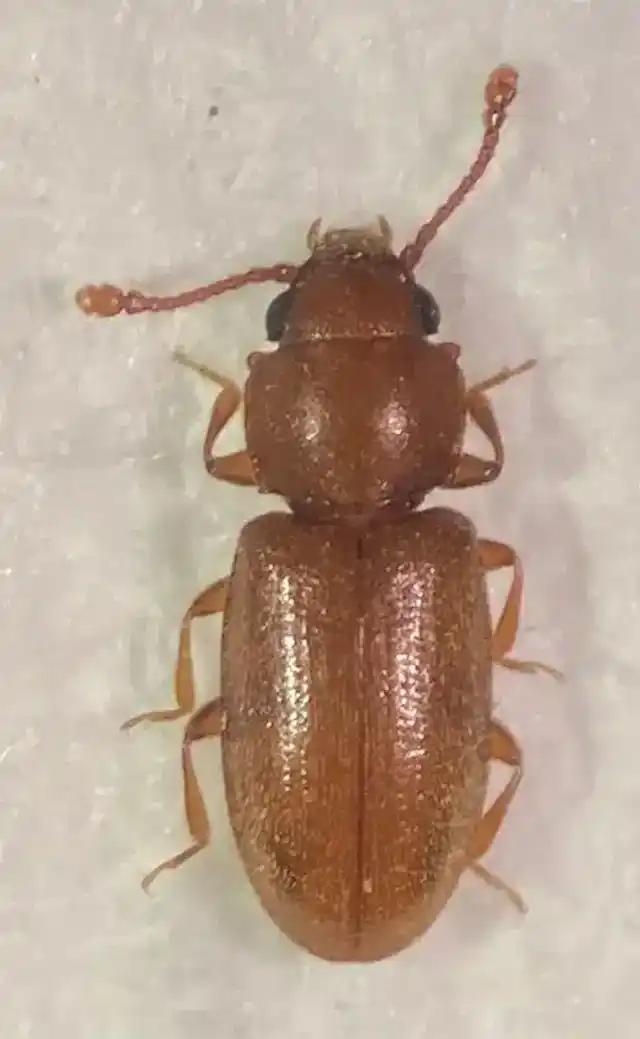

TLDR: Foreign grain beetles in the bathroom, bedroom or anywhere else in the house mean there’s damp, moldy material nearby, usually inside a wall or under a vanity. They eat mold, not grain. They fly toward lights, which is why they turn up on window sills and in beds. They don’t bite. Vacuum the ones you see, then get the humidity under 60% and fix any leak. In a new house they usually fade within one to two years as the building dries.
If you keep finding tiny reddish-brown beetles on the bathroom counter, the window sill or your pillowcase, you’re probably looking at a foreign grain beetle. It’s one of the most common “what is this bug?” photos we get from homeowners in late summer.
The name throws people off. Foreign grain beetles rarely touch your pantry. They feed on the mold that grows on damp wood, drywall and particleboard. So the beetle itself isn’t the real problem. It’s telling you where the moisture is.
Why Foreign Grain Beetles Show Up in Your Bathroom
The bathroom is where most people first notice them, and there’s a simple reason. Every shower puts a lot of water into the air. If the exhaust fan is weak, or nobody runs it, that moisture soaks into drywall paper, the particleboard inside the vanity and the framing behind the tile. Mold grows on those surfaces long before you can see it, and foreign grain beetles feed on it.
Texas A&M AgriLife Extension notes that in older homes, foreign grain beetles are sometimes pests in bathrooms, where high humidity lets both the beetles and the mold they eat grow. The University of Minnesota Extension says they need humidity above 65% to reproduce and die off once it falls below 60%.
When I get a call about beetles in a bathroom, these are the spots I check first:
- Under the sink. A slow drip at the trap or supply line keeps the vanity floor wet. Particleboard swells and grows mold fast.
- Around the tub and shower. Cracked grout or failed caulk lets water into the wall behind the tile.
- The exhaust fan. If it doesn’t pull a tissue against the grille, it isn’t moving enough air. Some older homes don’t have one at all.
- Light fixtures and outlets. The beetles come out of the wall void through these gaps and head for the light.
- The wall shared with a laundry room or kitchen. A leak on the other side of the wall shows up as beetles on your side.
Our guide to tiny brown bugs in the bathroom covers the other small insects you might be seeing in there, like booklice and drain flies.
Grain Beetles in Your Bed or Bedroom
Finding a beetle on your sheets is unnerving, but it doesn’t mean they’re living in the mattress. Foreign grain beetles develop inside wall voids, then the adults wander out and fly toward light. A bedside lamp or a bright window is enough to pull them into the bedroom. They end up on the bed, the nightstand and the window sill because that’s where they landed.
They don’t bite people and they don’t feed on blood or fabric. If you’re worried it’s something worse, compare it to our carpet beetle vs bed bug guide. A bed bug is flat, oval and about the size of an apple seed. A foreign grain beetle is less than half that length and narrow, with a hard shell. If beetles keep showing up in one bedroom, look for moisture in that room’s exterior wall, a window that leaks or a bathroom on the other side of the wall.
Do Foreign Grain Beetles Fly?
Yes. Iowa State University Extension describes them as strong fliers that are attracted to lights. The University of Kentucky says the adults become a problem in mid to late summer, when they move out of wall voids and gather at windows and lights.
That’s why a problem seems to appear overnight. The beetles were breeding in the wall for weeks. You only see them once the adults start flying toward the light. Small numbers can also fly in from outdoors through torn screens and gaps around windows and doors.
Where Do Grain Beetles Come From?
Most of the time they come from inside your own walls. Here are the usual sources:
- Damp building materials. Lumber, drywall and joint compound that got wet grow a thin film of mold the beetles eat.
- Construction debris. The University of Kentucky points to sawdust left behind walls during building. The beetles lay eggs in it.
- Leaks and condensation. Plumbing leaks, roof leaks and sweating ductwork keep one area wet long enough for mold to grow.
- Damp crawl spaces and basements. These feed beetles into the floors and walls above.
- Outdoors. A few fly in from mulch and damp leaf litter, especially on warm nights with the porch light on.
- Moldy food. Rarely, a bag of flour, birdseed or pet food that got damp. Check these if you only see beetles in the pantry.
How to Identify Foreign Grain Beetles
Look for these features to confirm you have foreign grain beetles:
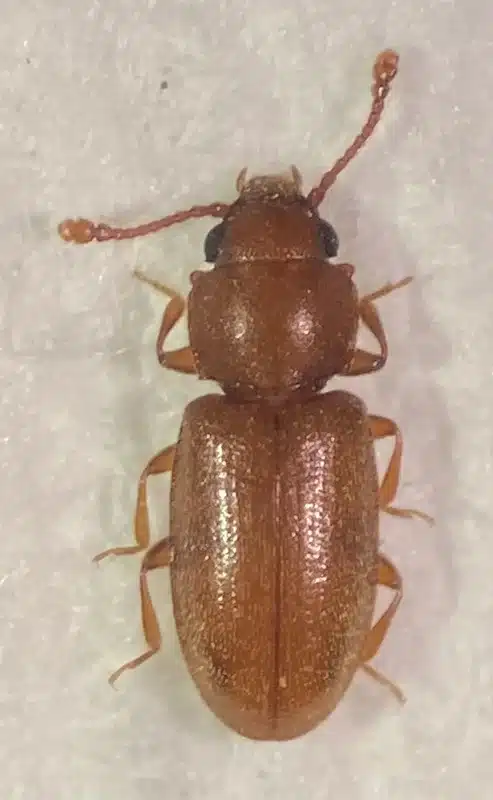
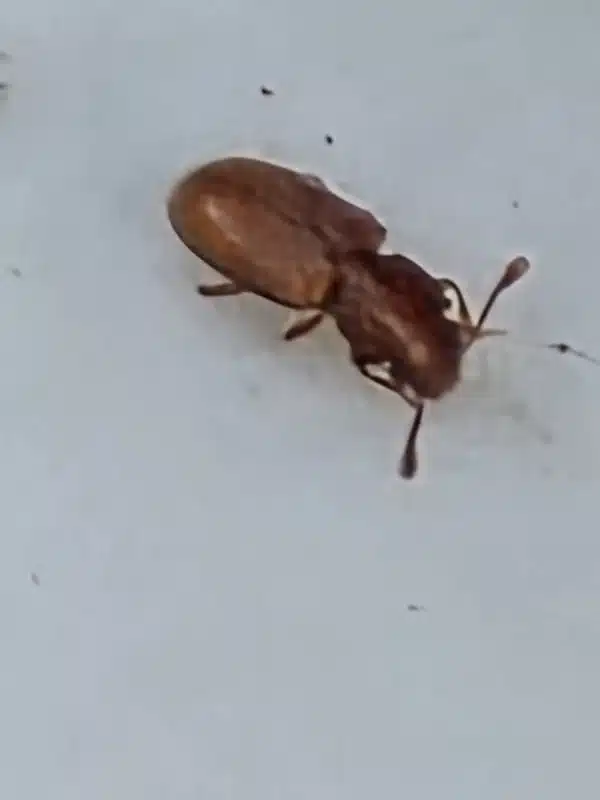
- Club-shaped antennae with three larger segments at the tip
- Two small nubs on the front corners of the plate behind the head (the pronotum)
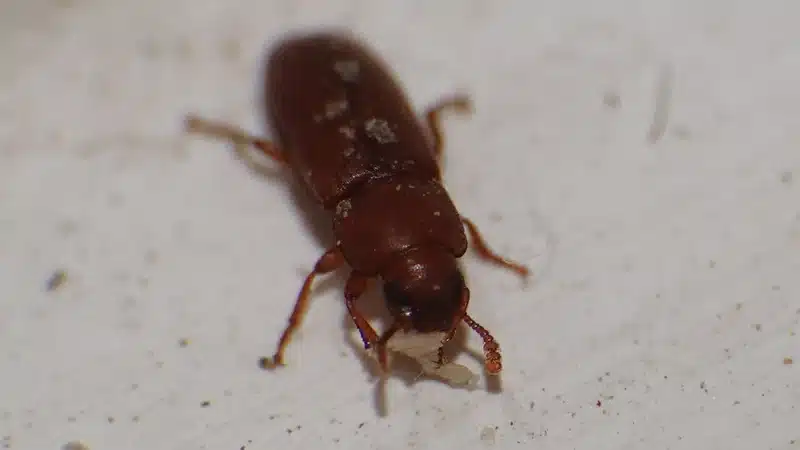
- Reddish-brown color throughout the body
- About 2mm long, roughly the size of a pinhead
The Canadian Grain Commission separates foreign grain beetles from look-alikes by their clubbed antennae and the small projections on the front edge of the pronotum. You’ll usually need a hand lens or a zoomed-in phone photo to see them.
Other small insects get mixed up with foreign grain beetles. Sawtoothed grain beetles have six tooth-like points down each side instead of two nubs, and they do eat dry food in the pantry. Fruit flies are soft-bodied and fly when bothered. For a full species profile with more photos and look-alikes, see our foreign grain beetle identification page.
Foreign Grain Beetles in New Construction
These beetles are so common in new homes that some people call them “new-house bugs.” New homes hold a lot of moisture because:
- Lumber still holds water from the build
- Paint, joint compound, and concrete release water as they dry
- Rain can soak framing before the walls are closed up
- HVAC systems may not be balanced right the first year
The Foreign Grain Beetle Lifecycle
These beetles breed fast when it’s humid. Purdue University Extension puts the full cycle at about 30 days in good conditions:
- Egg stage: 4-5 days
- Larval stage: 11-19 days, depending on temperature and humidity
- Pupal stage: 3-5 days before the adult comes out
- Egg laying: Females start 3-4 days after they emerge
Purdue reports that females usually lay 1-4 eggs a day, and as many as 8-12. They don’t breed when relative humidity is below 65% in most foods. That’s why drying the area out works so well. You stop the next generation, and the adults die off on their own.
Common Moisture Sources
When we get calls about these beetles, we spend most of the visit finding the moisture source. Common causes in Northern Virginia and Maryland homes include:
Structural issues:
- Poor ventilation in crawl spaces and basements
- Plumbing leaks behind walls or under slabs
- Roof leaks or ice dam damage
- High groundwater or bad drainage around the foundation
HVAC problems:
- Oversized or short-cycling systems that cool the air without pulling much moisture out
- Blocked vents or unbalanced airflow
- Not enough fresh-air ventilation in tight new homes
Clay-heavy soils in places like Falls Church and McLean hold water against the foundation and make basement moisture worse. That same moisture can also bring in carpenter ants and lead to wood rot.
Daren, one of our registered technicians, sees the same thing over and over with moisture pests. A customer swears the house is dry, so he has them set a hygrometer in the problem area. Plenty of times it comes back at 72% relative humidity. He tells people to aim for about 45-50%. He usually suggests a dehumidifier before any chemical, because taking away the damp conditions goes further than a spray does.
How to Get Rid of Grain Beetles in Your House
Vacuum beetles off window sills, counters and baseboards, then empty the canister outside. The University of Minnesota calls vacuuming the best short-term control. It gives you relief right away while you fix the cause.
Run a dehumidifier in the basement or crawl space and the exhaust fan in the bathroom during every shower and for a while after. Put a hygrometer in the room where you see the most beetles. You want it reading under 60%, and ideally 45-50%.
Fix plumbing leaks, re-caulk tubs and showers, and redirect gutters and downspouts away from the foundation. In crawl spaces, cover exposed soil with a vapor barrier. Throw out any flour, birdseed or pet food that got damp.
If beetles keep pouring out of one wall, a licensed technician can put an insecticide dust into that wall void. Texas A&M AgriLife Extension notes that general spraying gives little control. Treatment only buys time while the moisture fix takes hold.
| Approach | What It Does | How Long It Lasts |
|---|---|---|
| Vacuuming | Removes adults you can see | Days; repeat as needed |
| Humidity control | Removes the conditions beetles need to breed | Long-term, as long as you keep it up |
| Fixing leaks | Removes the mold’s water supply | Permanent for that source |
| Wall-void treatment | Kills beetles inside one problem wall | A few weeks |
Seasonal Patterns in Our Area
In Northern Virginia and suburban Maryland, these beetles follow the humidity:
- Late summer peak: August and September, when our dew points are highest
- Fall decline: October brings drier air and fewer beetles
- Winter lull: Running the heat usually drops indoor humidity below what they can survive
- Spring check: If they come back in spring, the moisture source is still there
The University of Kentucky describes the same mid-to-late-summer pattern, when adults leave the wall voids and head for windows and lights.

When to Call a Professional
Most new-construction beetle problems fix themselves as the building dries. Call a licensed technician if:
- Beetles keep coming after two summers
- Beetles show up in the middle of winter
- Large numbers keep coming out of the same wall, vanity or outlet
- You see water stains, soft drywall or visible mold
- Humidity stays high even with a dehumidifier running
Foreign grain beetles aren’t dangerous. But they point to moisture that can lead to mold or wood rot if you ignore it. Spraying the beetles without fixing the moisture won’t solve anything.
Better Termite & Pest Control has handled moisture-related pest problems across Alexandria, Fairfax, Bethesda, and the rest of Northern Virginia and suburban Maryland for 58+ years.
Get Help with Foreign Grain Beetles Today
If you’re dealing with foreign grain beetles or want to head off moisture-related pest problems, call us at 703-683-2000 or email info@bettertermite.com. With 1800+ reviews from local homeowners, we know how to find the moisture source and stop the beetles.