
Yes, diatomaceous earth can kill fleas, but only some of them, and slowly. It works best on flea larvae crawling through dry carpet. It kills adult fleas inconsistently, and it does nothing to flea eggs or to pupae sealed in their cocoons. So on its own, it rarely ends a real infestation.
Homeowners ask me about diatomaceous earth (DE) all the time. Most want a natural fix before they call anyone. Basically, I tell them it’s a useful helper, not a cure. Below, I’ll cover how it works, which flea stages it reaches, and how long it takes. I’ll also show you how to use it so you don’t waste a month on it.
How Diatomaceous Earth Kills Fleas
Diatomaceous earth is a fine powder. It’s made from the fossil shells of tiny algae called diatoms. To us it feels like flour. To a bug, it’s more like crushed glass mixed with a sponge.
According to the National Pesticide Information Center, DE soaks up the oils and fats in a bug’s waxy outer shell. Without that layer, the insect loses water and dries out. The sharp edges of the particles scratch the surface, too, which speeds things up.
This matters for fleas for two reasons. First, it’s a physical kill, not a nerve poison, so it works slowly. Second, it only works while the dust is dry and in contact with the insect. If it gets damp, or the flea doesn’t pick up enough of it, nothing happens.
A 2021 review in Molecules of diatomaceous earth for pest control found that relative humidity largely decides how well DE works. In one set of stored-grain insect tests it summarized, DE lost effectiveness as humidity rose from 55% to 65%. The review also shows that kill times for many insects are measured in days, not minutes. Soft-bodied insects, which dry out faster, are the most vulnerable. Flea larvae fit that description much better than hard-shelled adult fleas.
Which Flea Life Stages DE Actually Reaches
Fleas go through four stages: egg, larva, pupa, and adult. Here’s the catch: the adult fleas you see are only part of the problem. The rest are hidden in your carpet, pet bedding, and furniture as eggs, larvae, and cocoons.
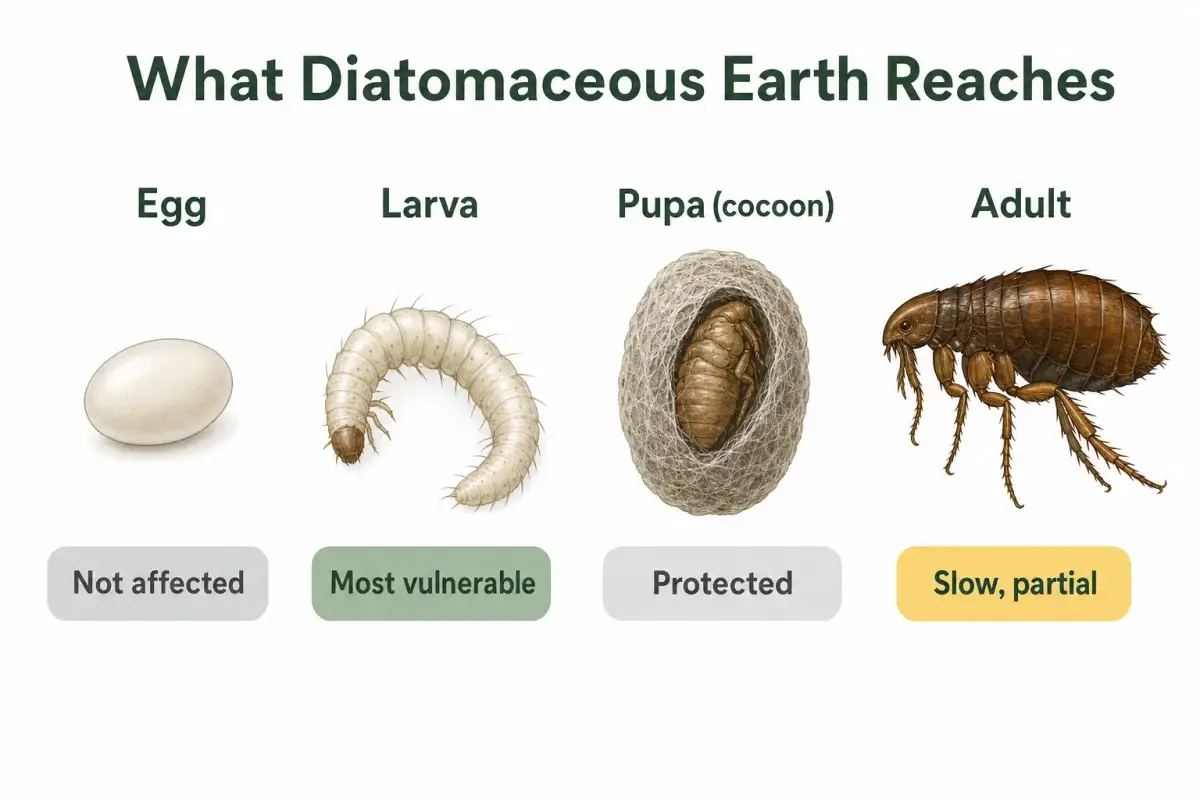
| Flea stage | Does DE kill it? | Why |
|---|---|---|
| Egg | No | Smooth, non-moving shell. Nothing for the dust to grab. |
| Larva | Yes, best target | Soft-bodied and crawls through carpet fibers where the dust sits. |
| Pupa (cocoon) | No | Sealed inside a silk cocoon that shields it. |
| Adult | Sometimes, slowly | Hard body, jumps away, and spends much of its time on your pet. |
The larva is DE’s real target. University of Florida entomologists note in their cat flea profile that DE has been used to control larvae in carpets. They also point out that adults emerge from their cocoons when they sense vibration or carbon dioxide. In other words, the pupae just wait until you or your pet walk by.
Adults are a different story. The University of Georgia’s cat flea guide goes as far as saying DE has no activity against adult fleas. I’d put it a little less strongly. An adult flea that sits in treated carpet long enough can die. However, most adults jump straight onto a pet and feed there, so they never pick up much dust.
How Long Does Diatomaceous Earth Take to Kill Fleas?
It depends on the stage and on how dry your house is. A flea larva that crawls through a good coating of DE can die within hours. An adult might take a day or two, or might not die at all if it only brushes the dust.
According to a veterinarian writing for PetMD, DE can start killing fleas within a few hours. Even so, it’s usually recommended to leave it down for about 48 hours before vacuuming. PetMD also notes that most vets don’t recommend DE. The main reason is that it doesn’t cover the whole flea life cycle.
The bigger timing issue is the cocoon. New adults keep emerging for weeks after you first treat. So even when DE is working, you’ll still see fleas for a while. That’s why one application almost never does the job.
Why DE Often Falls Short on a Real Flea Problem
DE sounds perfect on paper. In practice, three things work against it.
Fleas Love Humidity, and DE Hates It
Flea larvae grow best where the relative humidity is at least 75%, according to the University of Florida profile above. That’s the exact kind of air that weakens diatomaceous earth. Here in Northern Virginia and Maryland, our summers are humid. Basements and older homes often stay damp all year. So the places that grow fleas fastest are the same places where DE works worst.
One of our registered technicians, Daren, runs into this on moisture-related calls all the time. Plenty of customers swear their house is dry. When he has them set up a hygrometer, the relative humidity comes back at 72%. You want it closer to 45-50%.
The lesson carries straight over to fleas. If your house is running that damp, a dust that depends on staying dry is fighting uphill. A dehumidifier in the basement or bedroom helps your DE work better, and it makes the space less friendly to flea larvae, too.
It Misses the Stages That Restart the Problem
Eggs and pupae make up a big chunk of any flea infestation, and DE can’t touch either one. As a result, the population keeps refilling itself from the carpet even while the dust is down.
It Has to Be Everywhere the Larvae Are
Larvae hide deep at the base of carpet fibers, in pet bedding, under furniture, and in cracks along baseboards. DE only kills what it touches. Therefore, a light sprinkle in the middle of the room leaves most of the larvae untouched.
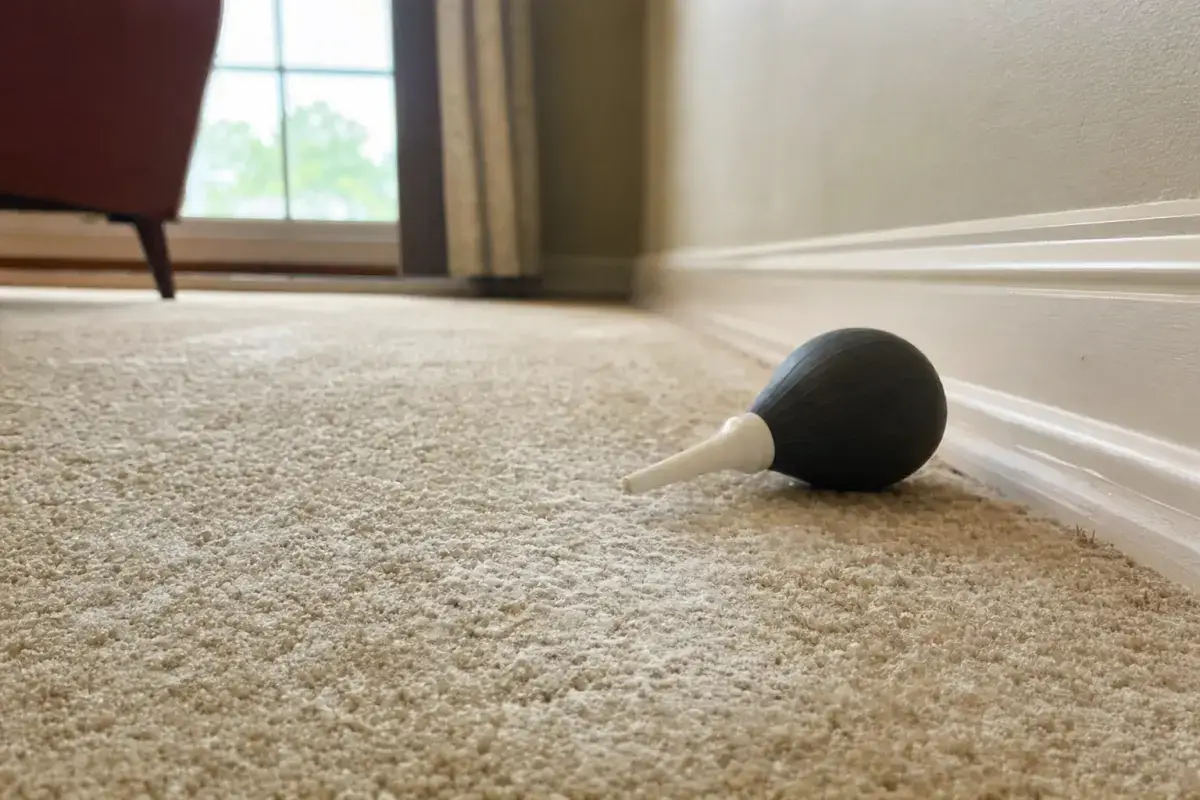
That’s why the edges of the room, under furniture, and your pet’s favorite spots matter most.
How to Use Diatomaceous Earth for Fleas
If you want to try DE, here’s how to give it a fair shot. For a deeper walkthrough of carpet-specific methods, see our guide on how to kill fleas in carpet.
Buy a registered DE product whose label lists fleas. The NPIC notes that there are more than 150 registered DE pesticide products, and the label tells you exactly where you can legally use it. Never use pool or filter-grade DE. It contains much more crystalline silica, which is a lung hazard.
Vacuum carpets, rugs, pet beds, and upholstered furniture thoroughly. The vibration also coaxes some adults out of their cocoons, which exposes them to the treatment. Empty the vacuum outside right away.
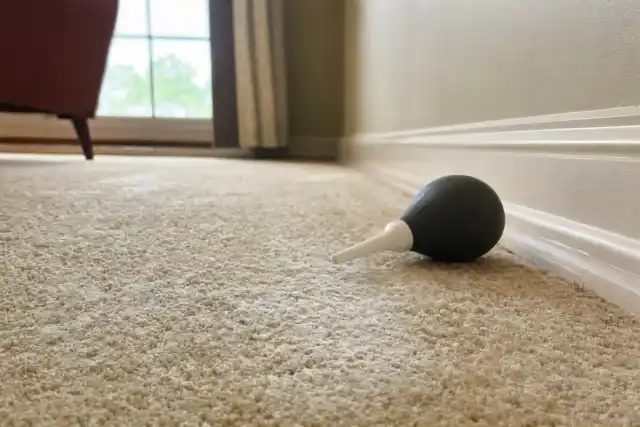
Put on a dust mask. Use a bulb duster or a flour sifter to spread a very thin, barely visible layer over carpets, along baseboards, and under furniture where your pet sleeps. Then brush it gently into the carpet fibers with a broom. Thick piles don’t work better. They just blow around and get into the air.
Keep kids and pets off the treated area. Leave the dust in place for about 48 hours so larvae crawling through the carpet have time to pick it up.
Vacuum thoroughly, then repeat the cycle about once a week for several weeks. The Texas A&M urban entomology program notes that the pupal stage normally lasts 7-14 days but can run much longer. So you need to keep treating until the last cocoons hatch.
Just as important is knowing where DE doesn’t belong. A few spots cause more harm than good.
What Works Better Alongside DE
DE is fine as one piece of a plan. It just can’t be the whole plan. Here’s what actually ends most flea problems:
- Treat every pet. A monthly preventive from your vet kills adult fleas where they feed. Without this, you’ll never catch up. Our cat flea page explains why this one species causes nearly every household flea problem, even on dogs.
- Use an insect growth regulator (IGR) indoors. IGRs stop eggs and larvae from developing into adults. They cover the gap DE leaves.
- Vacuum and wash constantly. Daily vacuuming and hot-water washing of pet bedding remove eggs and larvae before they grow.
- Handle the yard separately. If your pet spends time outside, the shaded areas under decks and in mulch beds may need their own treatment.
For a complete room-by-room plan, see our guide on how to get rid of fleas in the house. If your carpet is the main problem area, our step-by-step on getting fleas out of carpet covers vacuuming and steam cleaning in more detail.
The Bottom Line
So, does diatomaceous earth kill fleas? Yes, especially the larvae in dry carpet. However, it’s slow, it misses eggs and pupae, and humidity weakens it. For a couple of fleas brought home after a trip, DE plus vacuuming and a vet treatment might be enough. For an established infestation, it usually isn’t.
Better Termite & Pest Control has been helping Northern Virginia and Maryland families since 1968. We’re family-owned, with 1,800+ reviews and offices in Alexandria and Reston. Our licensed technicians focus on the areas where larvae and pupae hide, while your vet handles the fleas on your pets. All the products we use are EPA registered and have passed through our internal research team. Each one is something we’d feel comfortable using in our own homes.
If you have questions or want an estimate for flea control, call us at 703-683-2000 or email info@bettertermite.com.