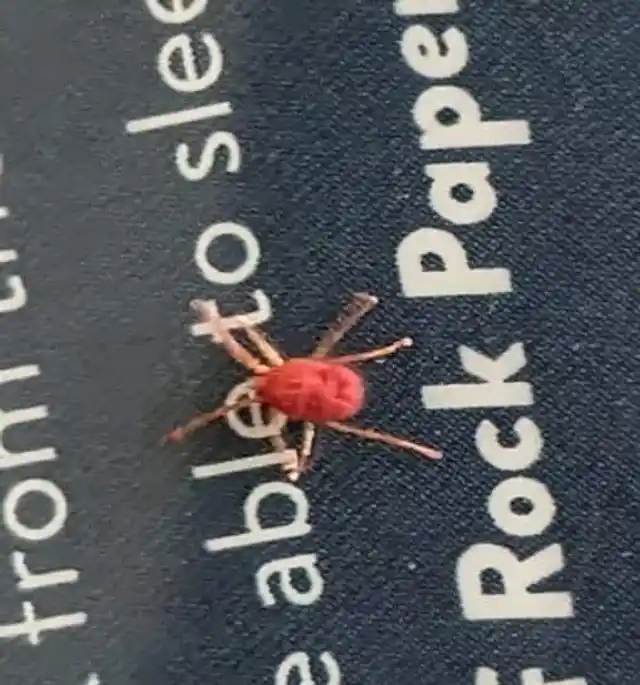

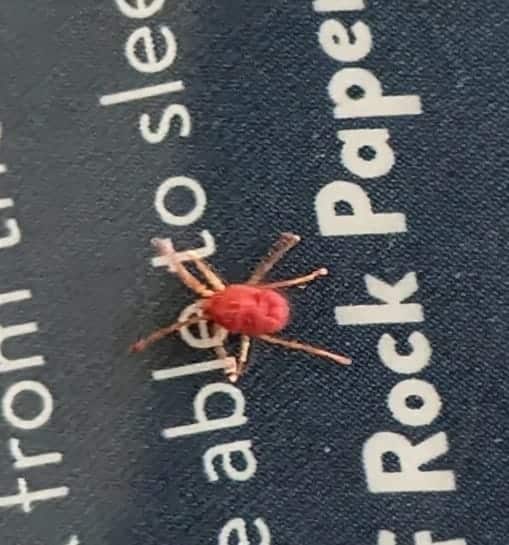
If you have tiny red bugs on your window sills and walls, and they leave a red smear when you press on one, you almost certainly have clover mites in your house. They wander in from the lawn, they don’t bite, and they can’t breed indoors. Getting rid of them is mostly a matter of removing them without crushing them and then fixing the strip of lawn along your foundation.
In the DC metro area we get a spike for a few weeks in spring and again in fall. In my experience, customers almost always find them on the sunny side of the house. They are almost always clover mites, and only rarely chiggers.
What Are Clover Mites?
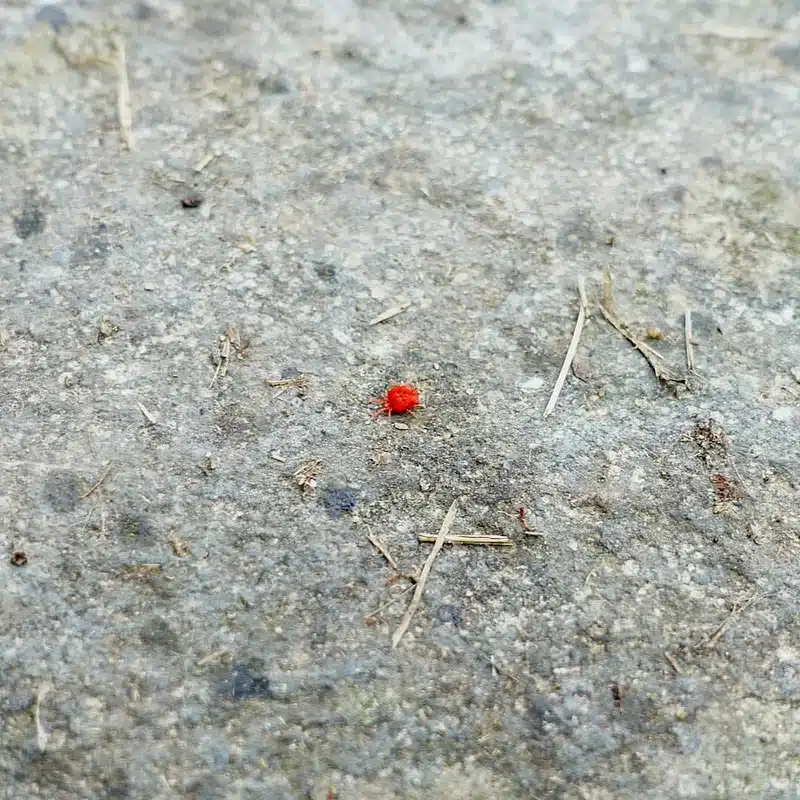
Clover mites (Bryobia praetiosa) are tiny arachnids related to spiders, not insects. They measure only 0.75 mm (about 1/30th of an inch), smaller than a pinhead and barely visible.
Adults are reddish-brown to olive colored. Newly hatched ones are bright red. According to Ohio State University Extension, their front pair of legs is twice as long as the others and points forward like antennae. This is the easiest way to ID them.
The best way to confirm clover mites is the crush test. When squashed, their body pigments leave rusty-red smears on walls, fabrics, and paper. Unlike chiggers, which bite people, clover mites only feed on plants outdoors. If you’re not sure which one you have, our clover mites vs chiggers comparison walks through the differences.
Why Are Clover Mites Red? (And Are There Black Clover Mites?)
The red comes from pigment in the mite’s body. That same pigment is what smears when you crush one. Color also changes with age. Newly hatched mites are bright red. Adults are rusty red, reddish-brown, or olive-green, per Clemson Extension. A dark olive adult sitting on a white sill can look almost black.
So “black clover mites” are usually just older clover mites, not a different pest. If the specks are dark gray, hop when you touch them, and don’t leave a red smear, you may have springtails instead. Our clover mite ID page has close-up photos to compare.
Where Do Clover Mites Come From?
Clover mites come from your lawn. They live and feed on grass, clover, and more than 200 other plants, according to Clemson Extension. In the fall they lay eggs under tree bark and in cracks in concrete, brick, and siding. Those eggs sit through winter and hatch when the weather warms.
The biggest populations build up in lush, well-fed grass. University of Missouri Extension ties larger numbers to newly laid lawns and to older lawns that have been heavily fertilized. Penn State Extension also links the rise in clover mite problems to more lawn fertilizer use.
Daren, one of our registered technicians, sees this on real jobs. The worst clover mite house he ever worked had an off-white stone patio so covered it looked like “a moving sea of red.” The homeowner’s daughter had a wedding coming up. Daren went back week after week for three or four weeks and treated the whole yard the way he would for a mosquito job to bring the numbers down. His advice from that job: “Clover mites come from the yard. They really pop after the lawn guys pump the yard with nitrogen fertilizer.” He tells customers to have their lawn company treat the yard itself, since that’s where the mites start. He also says nine times out of ten, people think they’re looking at ticks. Both are arachnids, and at a glance they look alike.
This page is about getting them out of the house. If you want the full list of conditions that draw them to one house and not the next (sun, siding, grass type, moisture), see what attracts clover mites.
When They Invade
Clover mites are cool-season pests that do best at around 69°F. They complete their growth in about one month during spring.
The whole population is female. They reproduce without mating. Ohio State research shows each adult lays about 70 eggs in cracks around mortar, siding, and bark.
In the DC metro area, clover mite problems peak during two seasons:
- Spring surge: March through June when soil temps rise
- Fall invasion: October through early December before winter dormancy
University of Maryland Extension says they’re most noticeable in spring when it’s between 45° and 80°F and humid, which describes most of April around here. When summer temps go above 85°F, eggs go dormant and numbers drop on their own. So each wave is short, usually a few weeks.

Why They Come Inside
Clover mites seek warm surfaces for egg-laying and overwintering. They’re drawn to south and west-facing walls where sunlight creates ideal warmth.
They slip in through hairline cracks around window casings, door sweeps, and foundation joints. University of Maryland Extension notes they are so small that window screens won’t stop them.
They aren’t looking for your house. They crawl up the warmest wall they can find, and a sunny brick or siding wall leads straight to the window frames. Homeowners often describe them as “moving dark specks,” and they can climb all the way to the second floor.
How to Spot an Infestation
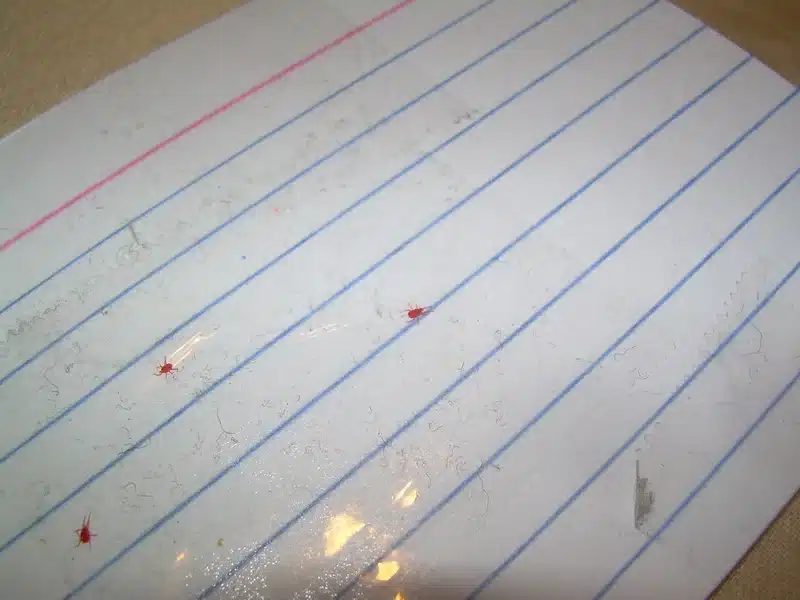
Look for clusters of tiny red dots moving slowly across white walls, window sills, or sunny windows. The red smears from crushed mites are a dead giveaway, especially on light-colored surfaces.
During peak periods, you may find hundreds around a single sunny window or door frame. Unlike ants in walls, they aren’t nesting inside. Every one you see came in from outside.
Early Detection Tips
Start checking exterior walls in late March and late September. Focus on sunny mornings when mites are most active. Look around sill plates, siding overlaps, and roof-wall joints on south and west-facing sides.
For outdoor populations, try the shake-sheet test: place white paper on grass near your foundation and tap the turf above it. Clover mites will fall onto the paper as tiny moving specks.
How to Remove Clover Mites Without Chemicals
Vacuuming is the most practical way to remove clover mites without staining. Use the crevice tool attachment and work gently to avoid crushing them.
Empty the vacuum outside right away so mites can’t escape back into your home. If you start seeing red smears, switch to wiping with a damp sponge instead.
For smaller numbers, wipe surfaces with a damp sponge using light pressure. Masking tape also works well for picking up individual mites from walls and window frames.
A thin film of mineral oil or cooking oil on window sills creates a sticky barrier that catches mites before they spread.
Clover mites don’t breed indoors and their numbers drop on their own. Steady vacuuming usually solves the problem within a few weeks.
How to Get Rid of Clover Mites on Window Sills
Window sills are where most people first see clover mites, and where they come back day after day. The sill is the warm, sunny landing spot at the top of the wall they just climbed. Here’s the order that works:
- Vacuum first, gently. Use the crevice tool and let the suction do the work. Don’t drag the nozzle across them. Get the corners and the track of sliding windows, where they pile up.
- Wipe what’s left with a damp cloth. Light pressure only. A wet microfiber cloth lifts them without smearing. If you see a red streak, you’re pressing too hard.
- Put a thin film of oil on the sill. Brush a little cooking oil or mineral oil along the sill and the outside edge of the frame. The mites get stuck in it and have trouble crossing it. Wipe it off and redo it every few days while they’re active.
- Lay double-sided tape along the sill if you’d rather not use oil. Replace it when it fills up.
- Caulk the frame from the outside. Check where the window trim meets the siding or brick. A gap there is usually how they reached the sill.
- Fix the outside of that wall. If grass grows right up to a sunny wall under that window, the mites will keep coming until that strip is cleared (see landscape prevention below).
According to University of Maryland Extension, thousands of clover mites can hide under shingles and window sills on a cool night, then start moving again when it warms up the next day. That’s why a sill you cleaned in the evening can be covered again by noon. The same guide recommends caulking window frames, adding weather-stripping, and lightly coating the sill with cooking or mineral oil.
Skip the bug spray on the sill. Spraying indoors won’t stop the ones still coming up the outside wall, and scrubbing a sill full of mites just crushes them into red streaks.
Sealing Your Home
Stopping clover mites from getting in means sealing very small gaps that most people miss. Screens won’t do it, so the caulk line matters more than the screen. Be realistic here, though. You won’t seal every crack in a house, so treat sealing as a way to cut the numbers, and pair it with the lawn changes below.
Focus on these areas:
- Window and door frame gaps (use silicone or latex caulk)
- Foundation expansion joints
- Utility openings where pipes enter the home
- Mortar cracks in brick or stone
- Where siding meets trim pieces
Upgrade weather-stripping around doors and windows. Replace worn door sweeps. Screen vents with 20-mesh hardware cloth instead of standard insect screening.
Landscape Prevention
Making changes around your foundation is one of the best long-term fixes.
- Gravel barrier: Install an 18-24 inch plant-free strip of gravel or coarse mulch around your foundation, especially on south and west-facing sides
- Plant choices: Replace grass near the foundation with marigolds, zinnias, chrysanthemums, or evergreen shrubs like juniper and yew
- Lawn care: Keep grass mowed to proper height and avoid heavy spring nitrogen that creates the tender growth mites love
- Water smart: Target irrigation to dry spots near the foundation where stressed grass draws more mites
Clover mites rarely cross bare soil or loose stone. Penn State Extension says removing grass from a 6- to 24-inch band next to the foundation deters them, and Clemson suggests a bare strip about 18 inches wide. If you only do one side, do the south and west walls.
Professional Treatment
When clover mite problems persist despite sealing and landscape changes, professional clover mite treatment can help. Most issues resolve with 1-2 targeted services.
We apply exterior perimeter treatments along foundation walls and a 10-20 foot lawn band. We use products like Essentria that meet our strict standards for residential use.
Timing matters. Spring treatments should target the March-June surge. Fall treatments work best during the October-December window. University of Minnesota Extension notes that treatments may need reapplication after heavy rain.
For indoor spaces, we stick to non-chemical methods rather than spraying inside. This matches extension guidance against routine indoor pesticide use for nuisance pests.
Our Clover Mite Services
At Better Termite and Pest Control, we’ve built field-tested approaches for clover mite problems based on 58 years of local experience. Our techs usually resolve problems with 1-2 targeted services.
Our TriGuard program includes clover mite coverage as part of tri-annual pest protection (three times per year). This keeps exterior barriers in place during peak activity so small populations don’t become major invasions.
We provide free unlimited callbacks between visits. If clover mites break through, we come back at no extra cost. No binding contracts. Cancel anytime with 30 days notice.
For expert help in the DC metro area, call us at 703-683-2000 or email info@bettertermite.com.