Running Crab Spiders Identification Guide
Philodromidae
Running crab spiders are fast-moving hunting spiders found throughout North America that catch prey by chasing it down rather than building webs. These agile spiders live on trees, shrubs, and low vegetation where they actively pursue insects.
Taxonomy
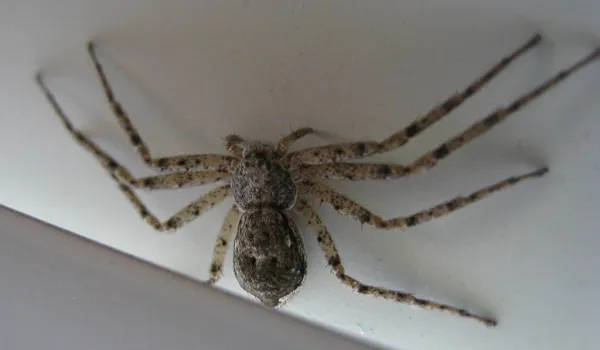
Running Crab Spiders Coloration
Common color patterns to help identify running crab spiders
Running Crab Spiders
Seasonal Activity
When running crab spiders are most active throughout the year
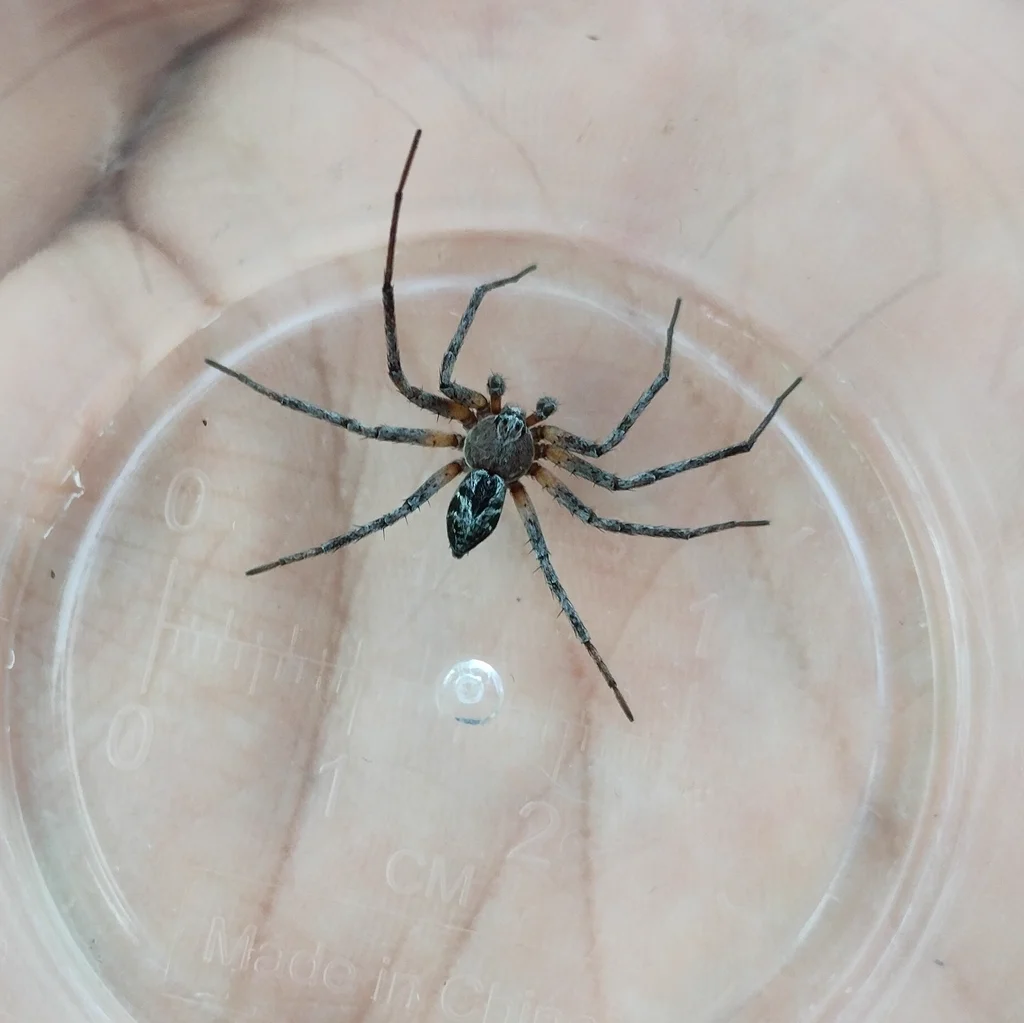

Where Running Crab Spiders Are Found
Hover over states to see their names. Green regions indicate where running crab spiders have been reported.
Running Crab Spider Identification Guide
Physical Characteristics
Running crab spiders (family Philodromidae) are fast-moving hunting spiders found throughout North America. Adults range from about 2 to 10mm in body length, with females generally larger than males. The family contains over 500 species worldwide in about 30 genera, with many species common in the United States and Canada.
The most recognizable feature of running crab spiders is their distinctively flattened body shape. Like true crab spiders (Thomisidae), they have a crab-like appearance with legs oriented sideways (called laterigrade). However, running crab spiders have one key difference: their second pair of legs is noticeably longer than the first pair. In true crab spiders, the first two pairs are much larger than the back pairs and roughly equal to each other.
Running crab spiders have eight eyes arranged in two horizontal rows of four. To distinguish between genera, scientists examine whether the posterior middle eyes are closer to the posterior lateral eyes than they are to each other. For everyday identification, the combination of flattened body, long second legs, and mottled coloration is usually enough.
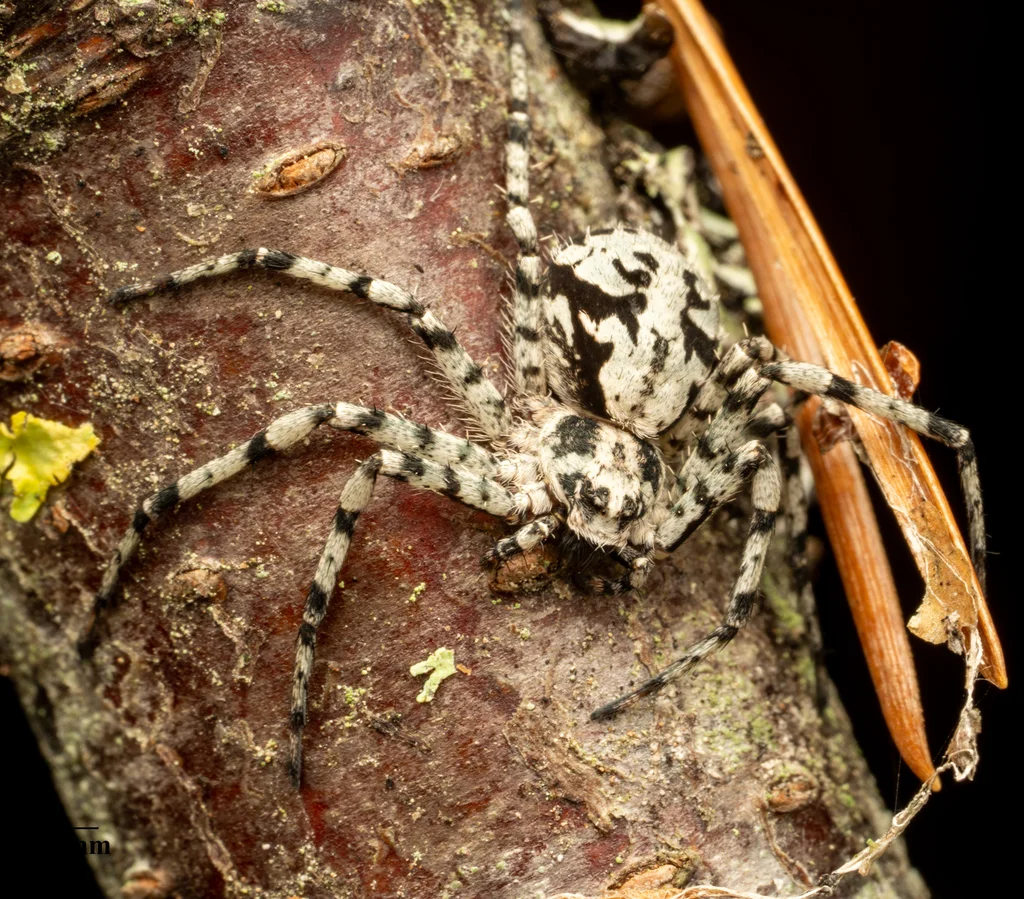
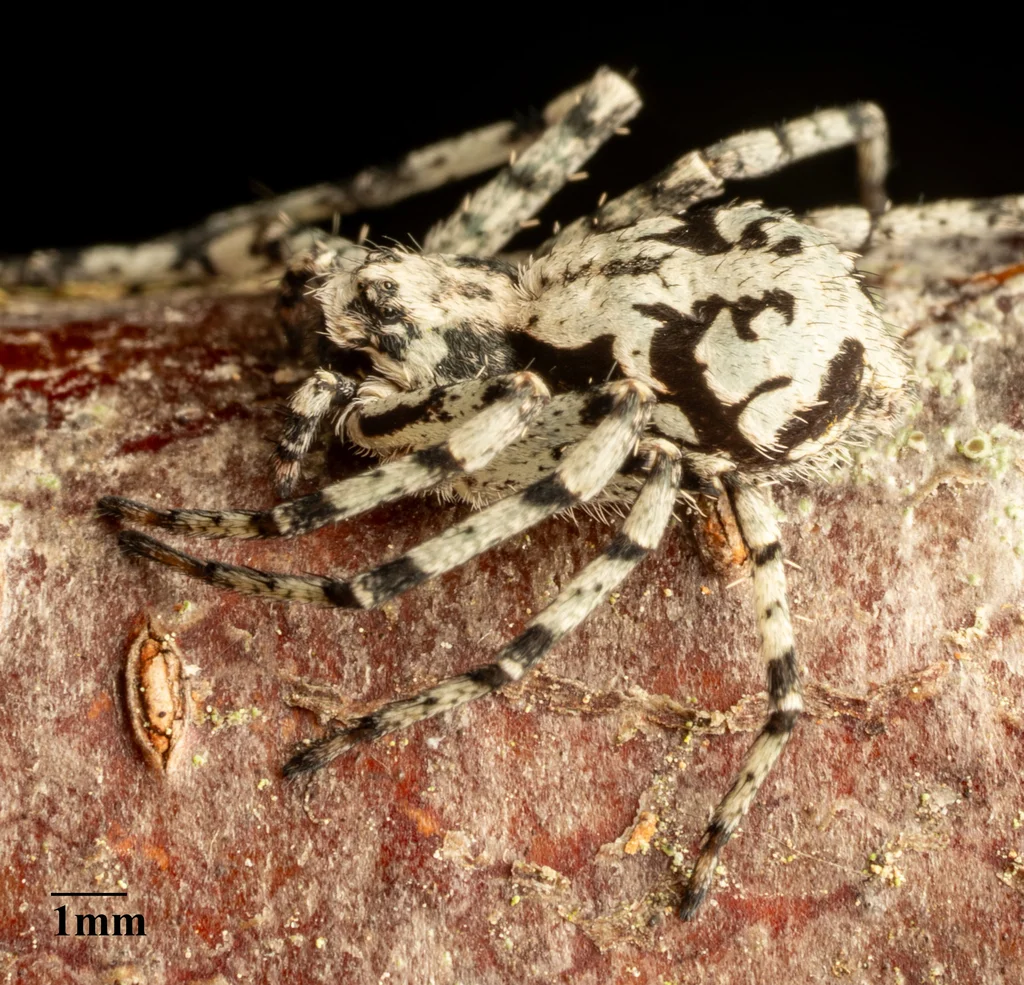
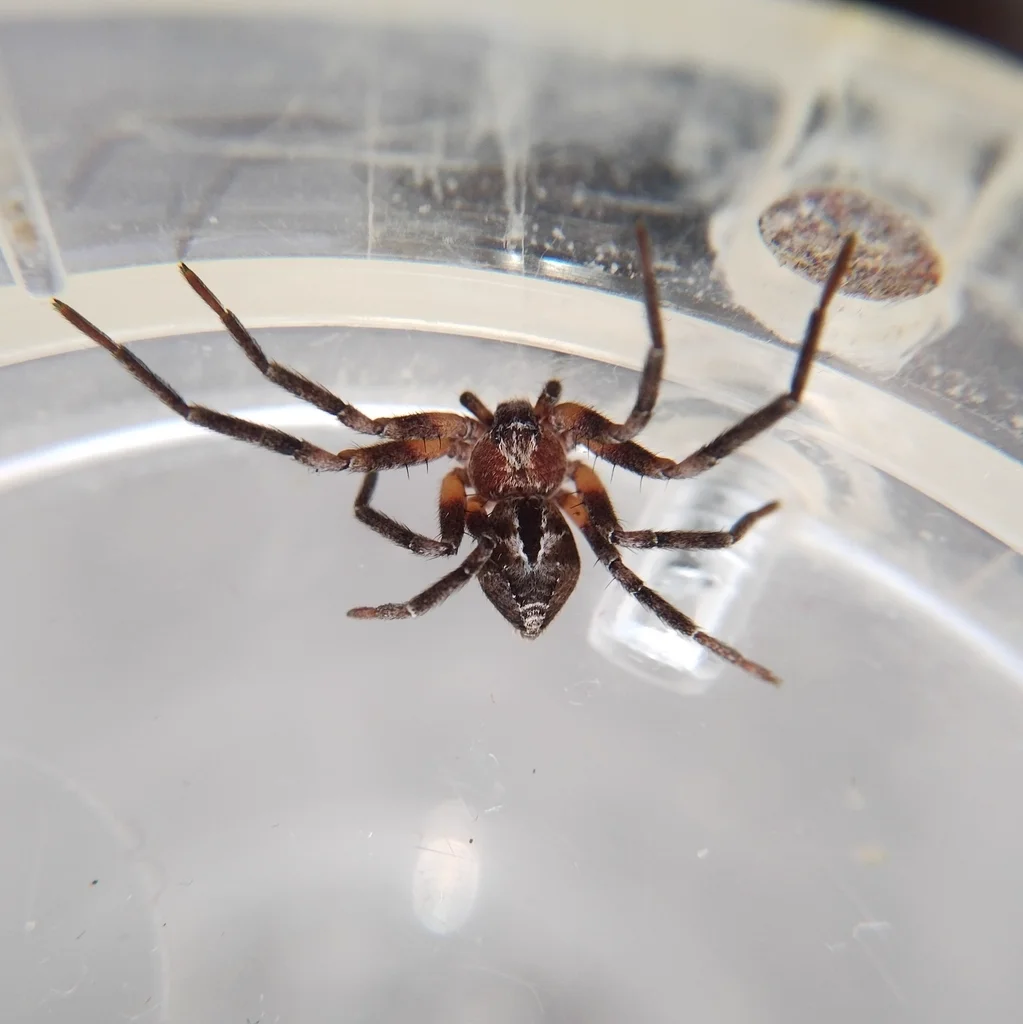
Their coloring provides excellent camouflage. Most species display mottled brown, tan, and gray patterns that blend in with tree bark and leaf litter. This cryptic coloring makes them difficult to spot when they sit motionless. Some species show variation between males and females, with males sometimes being darker or having distinct markings.
Common Species in North America
Several genera of running crab spiders are commonly found in North America:
- Philodromus (Philodromus spp.): The largest genus with over 250 species worldwide. These are the most commonly encountered running crab spiders. Body length typically ranges from 3-7mm. Colors range from tan and gray to reddish-brown.
- Thanatus (Thanatus spp.): Known as house crab spiders because some species commonly enter buildings where they catch flies. They have more elongated bodies than Philodromus.
- Tibellus (Tibellus spp.): Called slender crab spiders due to their long, thin bodies. They live in grass and low vegetation where their shape helps them hide along grass blades.
- Ebo (Ebo spp.): A genus of small, ground-dwelling running crab spiders found in leaf litter and low plants.
Distinguishing Running Crab Spiders from Similar Species
Running crab spiders can be confused with several other spider types:
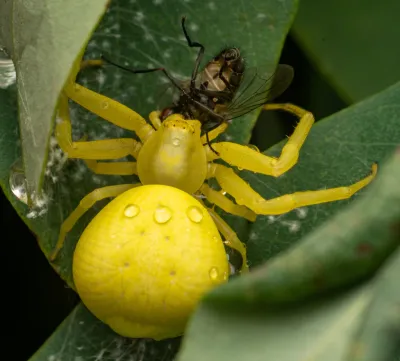
Compared to true crab spiders (Thomisidae):
- Running crab spiders have second legs longer than first legs
- True crab spiders have first two pairs of legs much larger and equal in size
- Running crab spiders actively chase prey; true crab spiders ambush from flowers
- Running crab spiders are typically dull brown/gray; true crab spiders are often brightly colored
Compared to wolf spiders:
- Running crab spiders have flattened bodies; wolf spiders are more robust
- Running crab spiders have legs held to the sides; wolf spiders hold legs more forward
- Running crab spiders are smaller (2-10mm); wolf spiders can reach 25mm or more
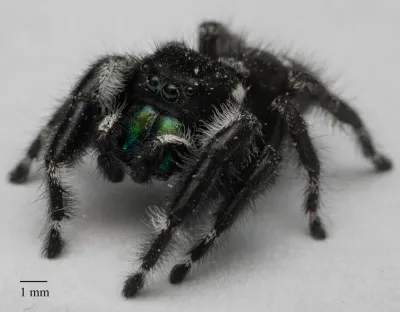
Compared to jumping spiders:
- Running crab spiders have smaller eyes in two even rows
- Jumping spiders have large, forward-facing front eyes
- Running crab spiders run smoothly; jumping spiders move in short hops
Running Crab Spider Behavior and Biology
Habitat Preferences
Running crab spiders occupy a variety of habitats across North America. According to documented sightings, they appear about equally indoors and outdoors, though they do not intentionally establish themselves in homes.
Outdoor habitats:
- Tree trunks and branches where bark provides camouflage
- Shrubs and low vegetation
- Open fields and meadows
- Forest edges and woodland clearings
- Gardens and landscaped areas
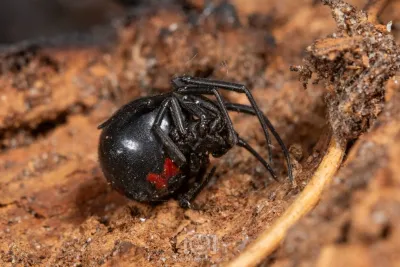
- Fence posts and outdoor structures A related species, Black Widow Spiders, shares similar characteristics.
Indoor occurrences: Running crab spiders found indoors are usually accidental visitors. They may enter through open windows and doors while hunting or be carried in on firewood, plants, or other materials from outdoors. They do not establish populations inside homes.
Their flattened bodies allow them to hide in narrow spaces under bark, in crevices, and between leaves. They rely heavily on camouflage and will remain motionless when first disturbed before fleeing at high speed.
Diet and Feeding Habits
Unlike web-building spiders, running crab spiders are active hunters that chase down their prey. They do not spin webs to catch food. Instead, they patrol their territory and actively approach insects that come within range.
What they eat:
- Aphids and other small soft-bodied insects
- Flies and gnats
- Mosquitoes
- Small beetles
- Other spiders (occasionally)
- Various agricultural pests
Running crab spiders are diurnal hunters, meaning they hunt during daylight hours. When they spot potential prey, they approach quickly and bite to inject venom that subdues the insect. Their speed allows them to catch prey that would escape slower ambush predators.
Some species serve as beneficial biological control agents. Philodromus cespitum, for example, helps control pests in orchards by eating aphids and other insects that damage fruit trees. This same species provides pest control in cotton fields in China and Iran.
Reproduction and Lifecycle
Running crab spider reproduction follows patterns typical of many spider species.
Mating behavior:
- Males are usually smaller than females
- Males court females by tapping on the female’s body with their front legs
- Females may initially flee or push away the male’s legs
- Males pursue females and continue tapping until the female becomes receptive
- Mating can be dangerous for males as females may attack them
Egg production:
- Females produce silk egg sacs containing many eggs
- Egg sacs are typically attached to vegetation or hidden in protected spots
- Females may guard their egg sacs from predators and parasites
- Development time depends on temperature and species
Development:
- Spiderlings emerge from the egg sac and disperse
- Young spiders molt several times as they grow
- Most species reach maturity within one year
- Adults typically live for one to two years total
Seasonal Activity Patterns
Running crab spider activity follows predictable seasonal patterns:
- December through February (None): Spiders overwinter in protected locations such as under bark, in leaf litter, or in building cracks.
- March (Low): Activity begins as temperatures warm. Overwintered spiders emerge to hunt.
- April and May (High): Peak activity period. Sightings are highest during April. Mating activity increases.
- June through September (Moderate): Continued activity throughout summer. Egg-laying occurs. Young spiders mature.
- October (Low): Activity decreases as temperatures drop. Spiders seek overwintering sites.
- November (None): Most spiders have entered dormancy for winter.
How We Treat for Running Crab Spiders
Running crab spiders rarely require treatment. They do not build webs indoors, pose no threat to humans, and actually help control pest insects. However, if spider activity around your property is concerning, we can help reduce overall spider numbers.
Our Assessment and Approach
Step 1: Inspection
When customers report spider concerns, we inspect to identify species and activity levels. For running crab spiders, we check:
- Trees and shrubs near the house
- Bark and foliage where spiders may hide
- Entry points where spiders might wander inside
- Conditions attracting the insects that spiders eat
Step 2: Conducive Condition Assessment
Running crab spiders near homes typically indicate healthy insect populations. We evaluate:
- Outdoor lighting that attracts flying insects
- Trees and shrubs touching or near the house
- Dense vegetation providing spider habitat
- Window and door screens (missing or damaged)
- Gaps around windows, doors, and utility penetrations
Step 3: Habitat Modification Recommendations
For running crab spiders, we often recommend these steps before treatment:
- Install or repair window and door screens
- Trim branches and vegetation away from the house
- Create a vegetation-free zone around the foundation
- Reduce outdoor lighting or switch to yellow “bug lights”
- Close blinds at night to prevent interior lights from attracting insects to windows
- Seal gaps around doors, windows, and utility lines
When Treatment Is Needed
If spider activity remains a concern after habitat modifications, our exterior barrier treatments will reduce spider populations. Treatment includes:
- Non-repellent products applied around the exterior perimeter
- Focus on areas where spiders are active
- Treatment of window and door frames
- Interior spot treatments only in specific problem areas if needed
Customer Guidance
For running crab spiders specifically:
- These spiders help control pest insects and are beneficial
- They do not bite humans and are not dangerous
- Finding them indoors is usually accidental
- Spiders found inside can be captured with a cup and paper and released outside
- Their presence indicates healthy insect populations nearby
Our tri-annual pest control service addresses common household pests. This also helps manage spider numbers by reducing the insects they feed on. Visit our spiders page for more information on species in the area.
References and Further Reading
- Philodromidae (Wikipedia): Overview of running crab spider biology and taxonomy
- Philodromidae Running Crab Spiders (SpiderID): Identification resources and sighting data
- Family Philodromidae (BugGuide): North American species information
- Philodromus cespitum (Wikipedia): Information on a common species and its role in biological control
- A Rundown on Running Crab Spiders (SpiderMentor): Detailed species information
Other Spiders
Explore other species in the spiders family
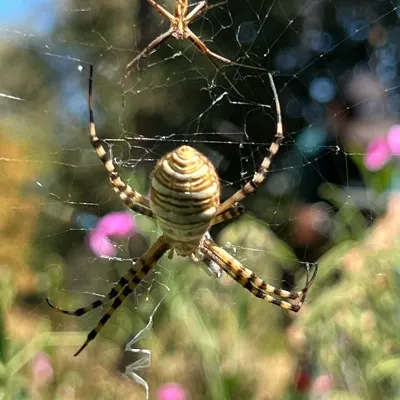
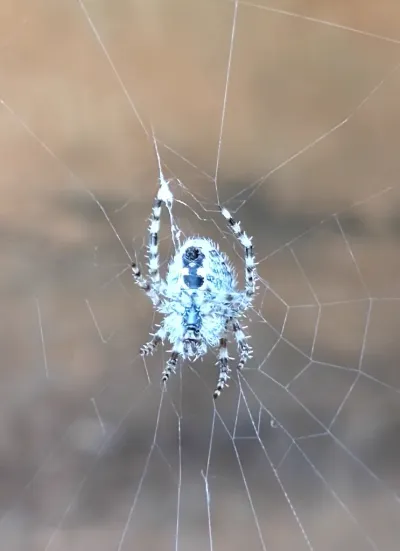
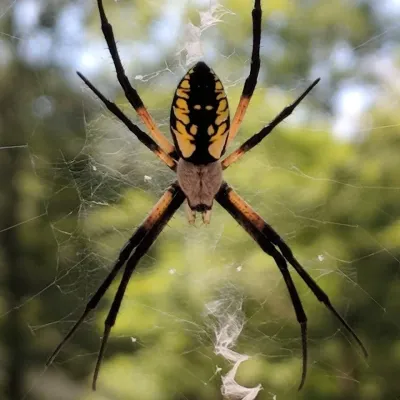
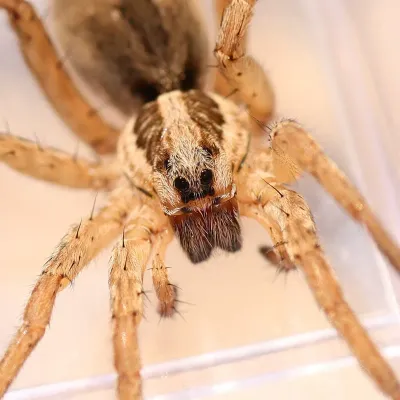
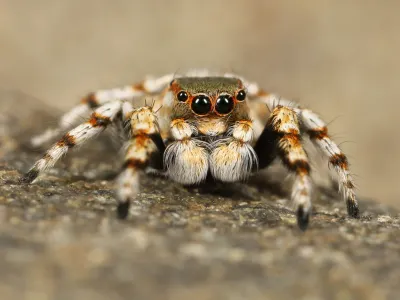
Commonly Confused With
Running Crab Spiders are often mistaken for these similar pests
Where Running Crab Spiders Are Found
Hover over states to see their names. Green regions indicate where running crab spiders have been reported.
Common Questions about Running Crab Spiders
Are running crab spiders dangerous to humans?
+
No, running crab spiders are not dangerous to humans. While they have venom to subdue their insect prey, their small fangs rarely penetrate human skin. If a bite were to occur, it would cause only minor, temporary irritation similar to a mosquito bite. These spiders are not aggressive and prefer to flee rather than bite.
What is the difference between running crab spiders and true crab spiders?
+
Running crab spiders (Philodromidae) and true crab spiders (Thomisidae) look similar but hunt differently. True crab spiders are ambush predators that sit still on flowers waiting for prey. Running crab spiders actively chase down their prey at high speeds. Running crab spiders also have more evenly-sized legs, while true crab spiders have much larger front legs.
Why are they called running crab spiders?
+
Running crab spiders get their name from their crab-like body shape combined with their speed. Like true crab spiders, they have flattened bodies and can walk sideways. However, unlike true crab spiders that wait for prey, running crab spiders chase insects down at high speed, which is where the 'running' part of their name comes from.
Do running crab spiders build webs?
+
No, running crab spiders do not build webs to catch prey. They are active hunters that chase down insects on tree bark, branches, and foliage. They do produce silk for draglines (safety lines) and egg sacs, but they rely entirely on speed and agility for hunting rather than webs.
What do running crab spiders eat?
+
Running crab spiders eat a variety of small insects including aphids, flies, mosquitoes, and other soft-bodied insects. Some species serve as beneficial biological control agents in orchards and agricultural fields by preying on crop pests. They actively hunt during the day, approaching prey and using their speed to catch it.
Where do running crab spiders live?
+
Running crab spiders are found on tree trunks, branches, shrubs, and low vegetation. Their mottled brown and gray coloring helps them blend in with bark and leaves. They spend most of their time outdoors but occasionally wander into homes through open doors and windows. They have been documented both indoors and outdoors about equally.
How fast can running crab spiders move?
+
Running crab spiders are extremely fast for their size and can move quickly enough to outrun most predators. They are difficult to catch by hand due to their speed and agility. When disturbed, they may also drop from their perch and hang in the air on a silk dragline.
When are running crab spiders most active?
+
Running crab spiders are most active during spring, particularly in April and May. They are diurnal hunters, meaning they hunt during daylight hours. Activity decreases during the hottest summer months and picks up again in early fall before they seek shelter for winter.

With five years of hands-on experience in the pest control industry, George Schulz is a registered technician with the Virginia Pest Management Association and a proud third-generation professional in a family business that's been protecting homes for over 57 years. He manages and trains a team of service pros while also leading internal research efforts—recently spearheading a deep-dive review of thousands of documents on pest control materials to hand-pick the most kid and pet friendly, most effective solutions tailored specifically for homes in the DC metro area.