Eastern Tent Caterpillar Moth Identification Guide
Malacosoma americanum
The Eastern tent caterpillar moth is a common North American species whose larvae build distinctive silk tents in the branches of trees. While the adult moths are harmless, the caterpillars can defoliate fruit trees and ornamental plants in spring.
Taxonomy
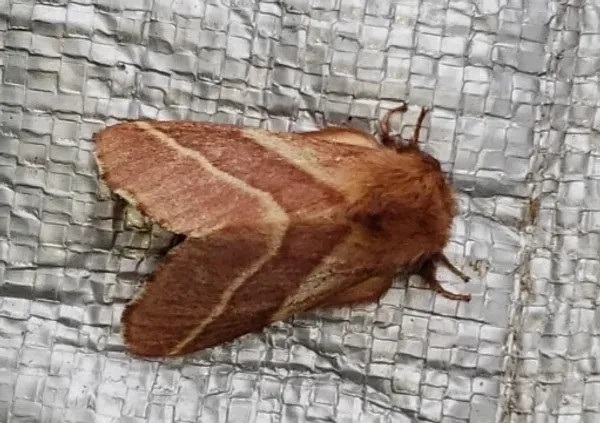
Eastern Tent Caterpillar Moth Coloration
Common color patterns to help identify eastern tent caterpillar moth
Eastern Tent Caterpillar Moth
Seasonal Activity
When eastern tent caterpillar moth are most active throughout the year

Where Eastern Tent Caterpillar Moth Are Found
Hover over states to see their names. Green regions indicate where eastern tent caterpillar moth have been reported.
Eastern Tent Caterpillar Moth Identification Guide
Physical Characteristics
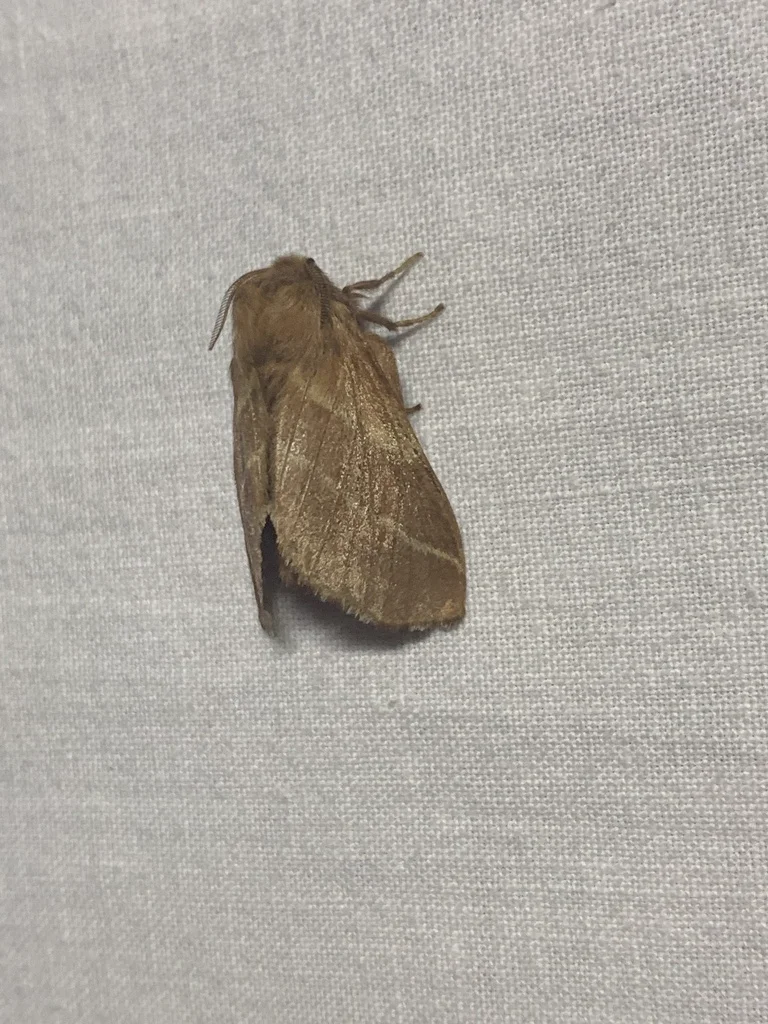
The Eastern tent caterpillar moth is a medium-sized moth with a thick body. Adult moths have a wingspan of 25 to 45mm, or about 1 to 1.75 inches. Both males and females are brown to reddish-brown. Two pale cream lines run across each forewing at an angle. The space between these lines often looks lighter than the rest of the wing.
Adult moths have thick, fuzzy bodies covered with long scales. Both sexes have feathery antennae. Male antennae are more feathered than female antennae. Female moths are larger and paler than males. They also have more rounded wings.
These moths only fly at night. They rest during the day. Adult moths do not eat at all. They live off energy stored when they were caterpillars. Their only job is to mate and lay eggs. Females give off scents to attract males. Mating usually happens the same day the moths come out of their cocoons.
Caterpillar Identification
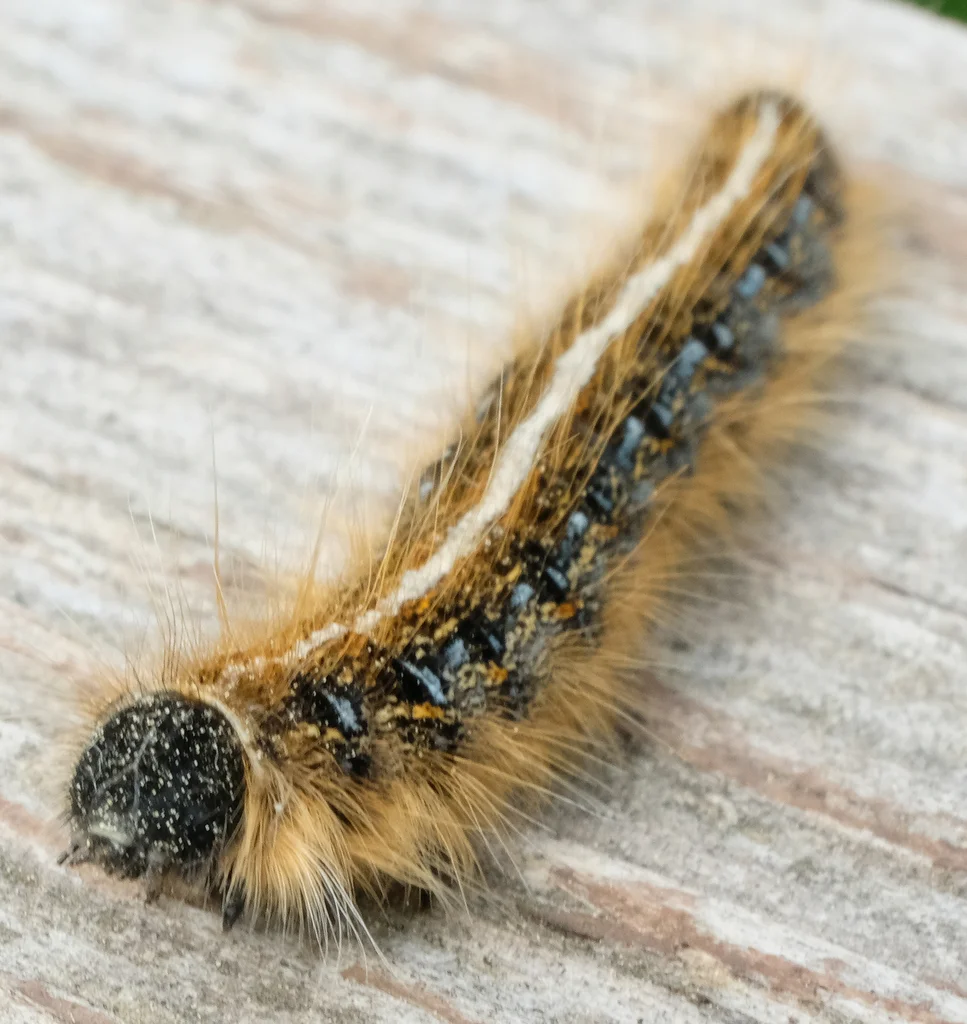
Most people see the caterpillars more often than the moths. Fully grown caterpillars are about 2 to 2.5 inches long. They have clear markings that make them easy to identify.
A solid white stripe runs down the middle of their back. Brown and yellow lines border this stripe on each side. Blue oval spots appear along the sides between body segments. Fine, soft hairs cover the whole body. These hairs are longest on the sides.
The head is dark brown or black. Young caterpillars are smaller and harder to identify. They get their full colors as they grow through six stages.
The Silk Tent
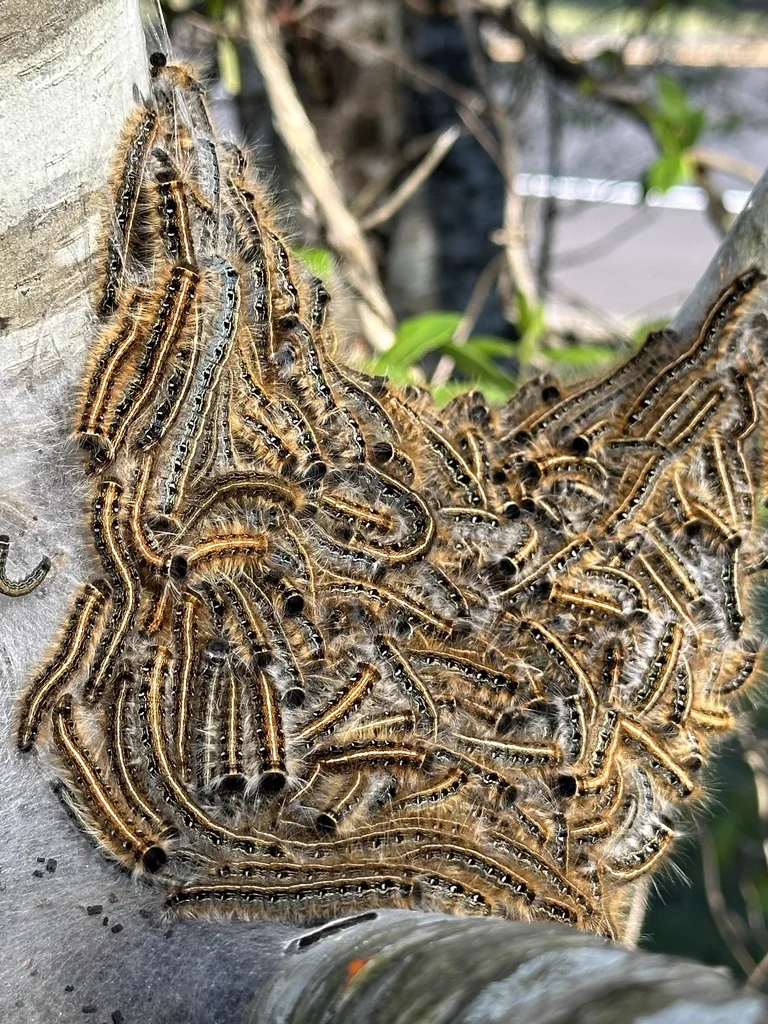
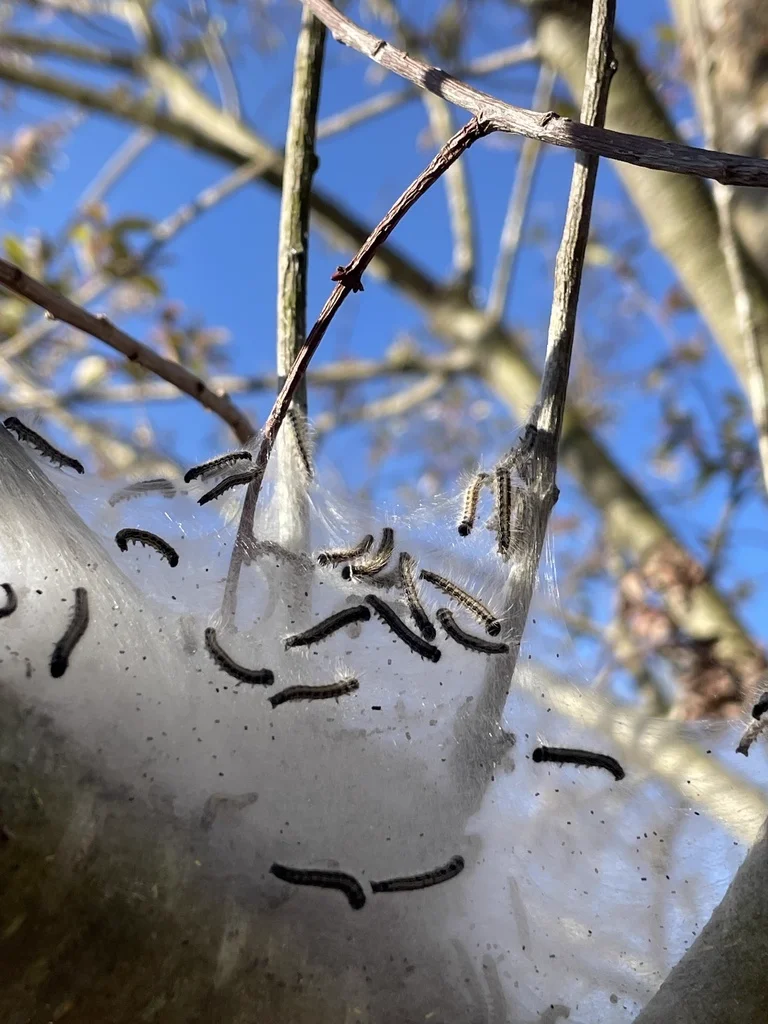
The easiest way to spot Eastern tent caterpillars is by their silk tent. These white, silky masses form in the forks of tree branches, which is different from fall webworms that build their webs at branch tips. Caterpillars start building the tent right after hatching. They make it bigger as they grow.
The tent is home base for the colony. Caterpillars go back to it after eating to rest and shed their skin. It also protects them from weather and animals that might eat them. They leave the tent to feed three times a day: before dawn, in the afternoon, and after sunset. When it is cold or rainy, they stay inside.
Tents can grow to 12 inches across or more during bad outbreaks. You may see many tents in a single tree when there are a lot of caterpillars.
Eastern Tent Caterpillar Behavior and Biology
Lifecycle and Development
Eastern tent caterpillars have one generation per year, and their lifecycle is described in more detail on our tent caterpillars overview page. Their lifecycle follows the same pattern each year.
Eggs: Female moths lay 150 to 400 eggs in a tight band around small twigs. The eggs have a shiny, dark brown coating that protects them through winter. Moths lay eggs in June or July. Tiny caterpillars form inside within three weeks but stay dormant until spring.
Larvae: Caterpillars chew out of the eggs in early spring when tree buds start to open. They begin building their silk tent right away. Over seven to eight weeks, they grow through six stages. They get bigger after shedding their skin each time. Homeowners dealing with Eastern Tent Caterpillar Moth may also encounter Moth, which can appear in similar environments.
Pupae: When caterpillars reach full size in late May or early June, they leave the tent. They look for sheltered spots to change into moths. They spin yellowish or white silk cocoons in rolled leaves, bark cracks, fence posts, or under roof edges. This stage lasts two to three weeks. A related species, Armyworms, shares similar characteristics.
Adults: Moths come out of cocoons in June and July. They live only one to two weeks. Females mate and lay eggs within a day or two. Then they die. A related species, Peachtree Borer Moth, shares similar characteristics.
Social Behavior A related species, Black Cutworm, shares similar characteristics.
Eastern tent caterpillars are very social. Brothers and sisters from the same egg mass stay together. They work as a group to build and care for their tent. A related species, White-marked Tussock Moth, shares similar characteristics.
When caterpillars sense danger, they defend themselves in a unique way. They thrash the front of their bodies back and forth. This movement spreads quickly through the group. Dozens of caterpillars may thrash at the same time. This can scare off animals trying to eat them.
Caterpillars also lay down silk trails as they travel between the tent and places to eat. These trails have scents that help other caterpillars find food and get back to the tent.
Host Trees and Feeding
Eastern tent caterpillars mainly eat trees in the rose family. Their favorite trees include:
- Wild cherry and black cherry
- Chokecherry
- Apple and crabapple
- Flowering cherry trees
- Hawthorn
When these trees are not around or already eaten, caterpillars may feed on other trees like maple, oak, birch, ash, poplar, and willow.
Caterpillars eat whole leaves. They leave only the center vein behind. They can strip all the leaves from a small tree in a few weeks. Healthy trees usually grow new leaves, but this uses up stored energy.
Signs of Eastern Tent Caterpillar Activity
What to Look For
- Silk tents: White, silky masses in branch forks, most visible in April and May
- Defoliated branches: Bare branches with only leaf stems remaining near tents
- Egg masses: Shiny dark bands encircling small twigs, visible in winter
- Wandering caterpillars: Mature larvae crawling on trees, buildings, and ground in late spring seeking pupation sites
- Frass: Small dark droppings beneath infested trees
- Adult moths: Brown moths near lights in early summer evenings
Damage Assessment
The main worry with Eastern tent caterpillars is damage to how trees look and tree stress from losing leaves. Here is what to look for:
Minor problems: One or two small tents per tree. The tree will recover on its own. Removal is up to you.
Moderate problems: Many tents causing clear leaf loss. The tree will grow new leaves but uses stored energy. You may want to remove the tents.
Serious problems: Large parts of the tree lose their leaves. Repeated heavy damage over several years can weaken trees. Treatment is a good idea.
Healthy, well-rooted trees can handle losing their leaves once in a while. Young trees, newly planted trees, and trees already stressed by lack of water or disease may be hurt more.
Treatment Methods for Eastern Tent Caterpillars
You can control Eastern tent caterpillars by removing tents by hand or using treatments when needed.
Physical Removal
The easiest way to deal with tent caterpillars is to remove tents by hand. This works best for small problems on trees you can reach.
- Remove tents in early morning or evening when caterpillars are inside
- Use a stick, pole, or gloved hand to pull down the tent
- Drop the tent into a bucket of soapy water to kill the caterpillars
- Throw away the contents in sealed bags
- Never try to burn tents in trees because this damages branches
During winter, check trees for egg masses. These look like shiny, dark bands around small twigs. Cut them out and get rid of them before spring.
Targeted Treatments
For severe infestations, several treatment options can reduce caterpillar populations:
Bacillus thuringiensis (Bt): This bacterial product targets caterpillars. Apply to leaves when caterpillars are feeding. It works best on young larvae and does not harm birds or mammals.
Insecticidal soaps: Contact sprays that kill caterpillars when applied directly. Useful for tents and caterpillars you can reach. Requires thorough coverage.
Horticultural oils: Dormant oil sprays applied in late winter can smother egg masses before they hatch. Timing is key.
Professional arborists can treat large trees that are hard to reach. They can check how bad the problem is and suggest the right treatment based on tree health. Learn about how much pest control costs for professional treatment options.
Prevention Tips
Reducing Eastern tent caterpillar problems starts with watching your trees and good tree care:
- Inspect trees in winter: Look for egg masses on small branches and remove them
- Monitor in early spring: Watch for new tents when buds open
- Remove tents quickly: Small tents are easier to manage than large ones
- Maintain tree health: Trees that get enough water and nutrients recover faster from leaf loss
- Choose resistant varieties: When planting new trees, pick species that caterpillars do not prefer
References and Further Reading
- NC State Extension - Eastern Tent Caterpillar
- University of Wisconsin Horticulture - Eastern Tent Caterpillar
- Missouri Department of Conservation - Eastern Tent Caterpillar Moth
- Animal Diversity Web - Malacosoma americanum
- Penn State Extension - Eastern Tent Caterpillar
- Wikipedia - Eastern tent caterpillar
Other Moths
Explore other species in the moths family
Commonly Confused With
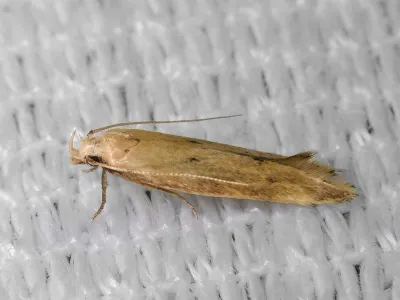
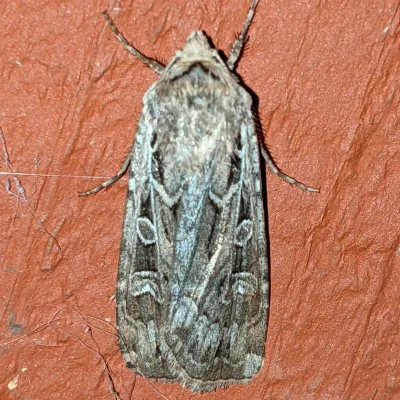
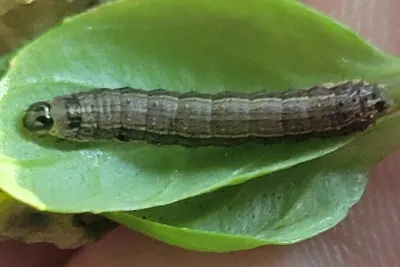
Eastern Tent Caterpillar Moth are often mistaken for these similar pests
Where Eastern Tent Caterpillar Moth Are Found
Hover over states to see their names. Green regions indicate where eastern tent caterpillar moth have been reported.
Common Questions about Eastern Tent Caterpillar Moth
What do Eastern tent caterpillars look like?
+
Eastern tent caterpillars are hairy caterpillars about 2 to 2.5 inches long when fully grown. They have a distinctive white stripe running down the center of their back, with brown and yellow lines along their sides. Blue spots appear on their sides between body segments. Their bodies are covered with fine hairs. The adult moths are brown to reddish-brown with two pale diagonal lines on each forewing.
Are Eastern tent caterpillars harmful to trees?
+
Eastern tent caterpillars can defoliate trees, especially cherry, apple, and crabapple trees. A single defoliation rarely kills a healthy, mature tree. The tree will typically produce new leaves within a few weeks. However, repeated defoliation over several years can weaken trees and make them more susceptible to other stresses and diseases.
When do Eastern tent caterpillars appear?
+
Eastern tent caterpillars emerge from their eggs in early spring, usually in March or April, when tree buds begin to open. They feed and grow through April and May, then pupate in late May or June. Adult moths appear in June and July, mate, lay eggs, and die within about two weeks. The eggs remain dormant until the following spring.
How do I get rid of Eastern tent caterpillar tents?
+
The most effective method is to remove tents by hand in early morning or evening when caterpillars are inside. Use a stick or gloved hand to pull down the tent and destroy the caterpillars. Do not burn the tents while they are in the tree as this can damage branches. Prune out egg masses during winter if you spot them wrapped around small twigs.
Do Eastern tent caterpillars bite or sting?
+
Eastern tent caterpillars do not bite or sting. However, some people may experience skin irritation from handling them due to their fine body hairs. The hairs can cause mild itching or rash in sensitive individuals. Wearing gloves when removing caterpillars or tents is recommended.
What is the difference between Eastern tent caterpillars and webworms?
+
Eastern tent caterpillars build their tents in the forks of tree branches and leave the tent to feed on leaves. They are active in spring. Fall webworms enclose leaves within their webs and feed inside, appearing in late summer and fall. Eastern tent caterpillar tents are compact and silky while webworm webs are loose and cover branch tips.
What trees do Eastern tent caterpillars prefer?
+
Eastern tent caterpillars strongly prefer trees in the rose family, especially wild cherry, black cherry, chokecherry, apple, and crabapple. They may also feed on hawthorn, maple, oak, birch, ash, and willow when their preferred hosts are unavailable. Ornamental flowering cherry and apple trees in yards are common targets.

With five years of hands-on experience in the pest control industry, George Schulz is a registered technician with the Virginia Pest Management Association and a proud third-generation professional in a family business that's been protecting homes for over 57 years. He manages and trains a team of service pros while also leading internal research efforts—recently spearheading a deep-dive review of thousands of documents on pest control materials to hand-pick the most kid and pet friendly, most effective solutions tailored specifically for homes in the DC metro area.