Buck Moth Caterpillars Identification Guide
Hemileuca maia
Buck moth caterpillars are dark, spiny stinging caterpillars that feed primarily on oak trees across eastern North America. Their hollow, branching spines deliver a painful sting on contact, causing immediate burning pain, welts, and swelling that can last several hours.
Taxonomy
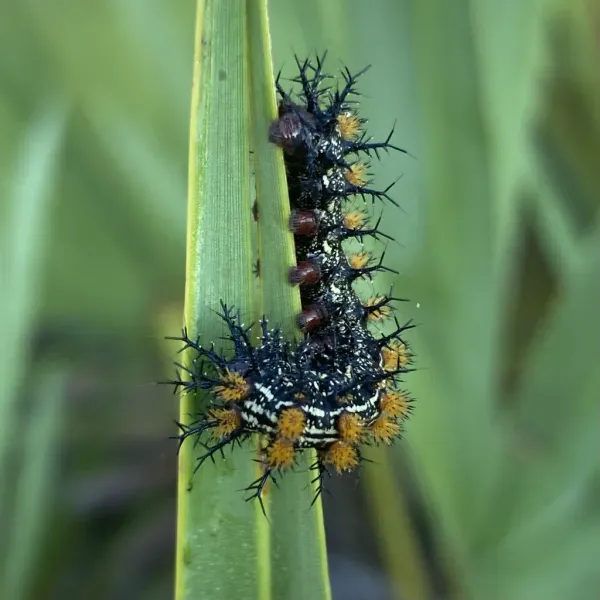
Buck Moth Caterpillars Coloration
Common color patterns to help identify buck moth caterpillars
Buck Moth Caterpillars
Seasonal Activity
When buck moth caterpillars are most active throughout the year
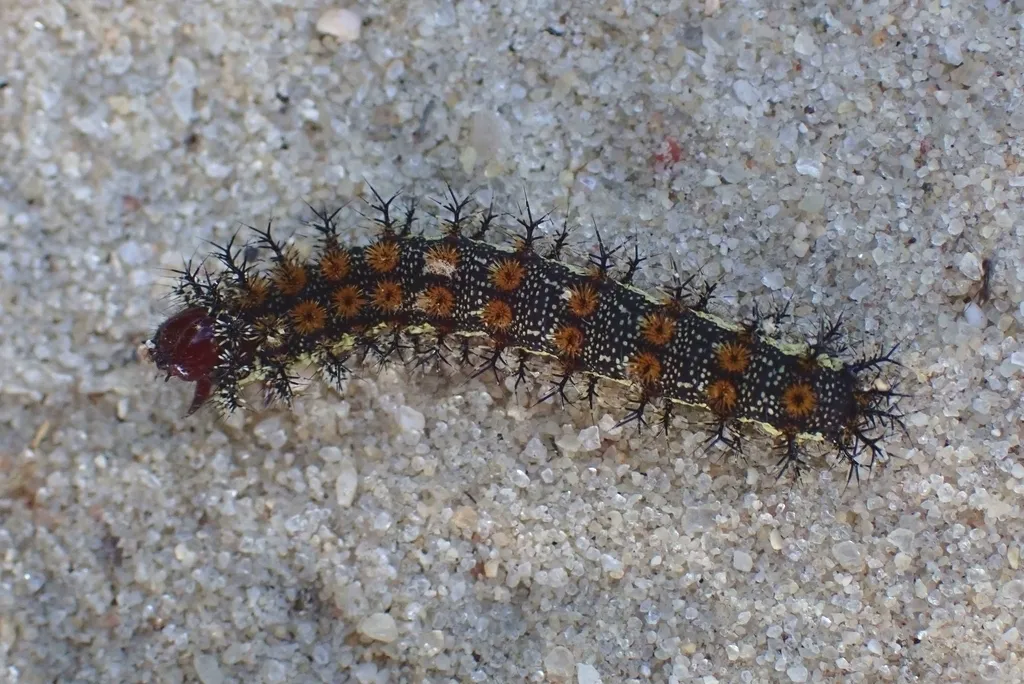
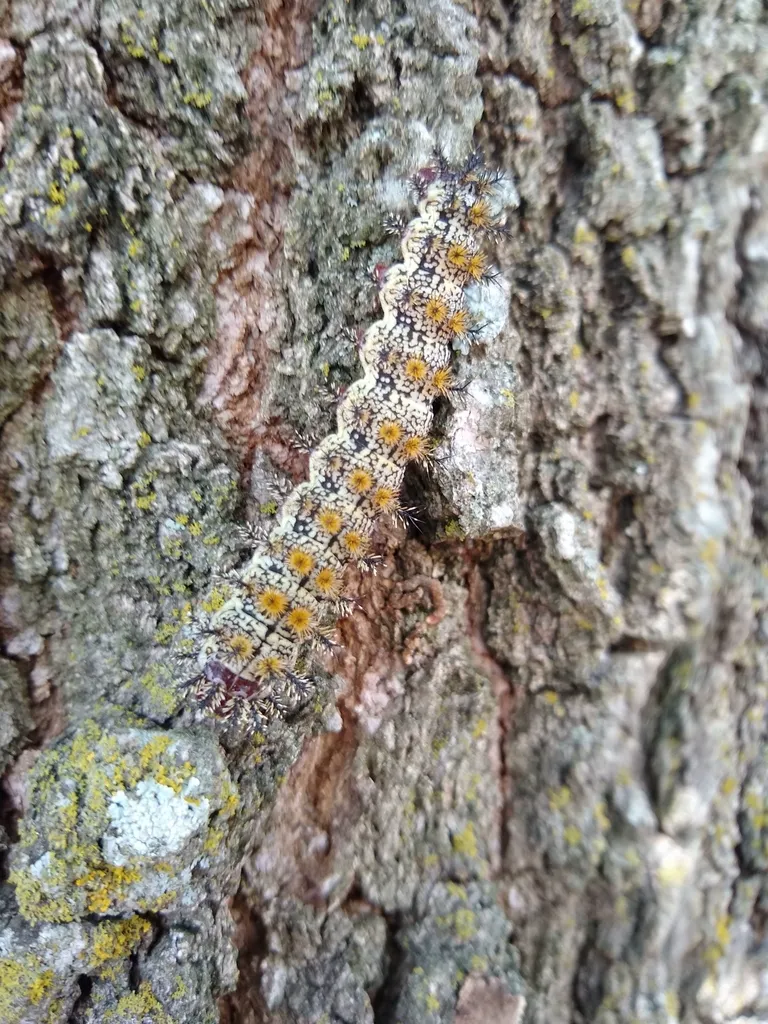
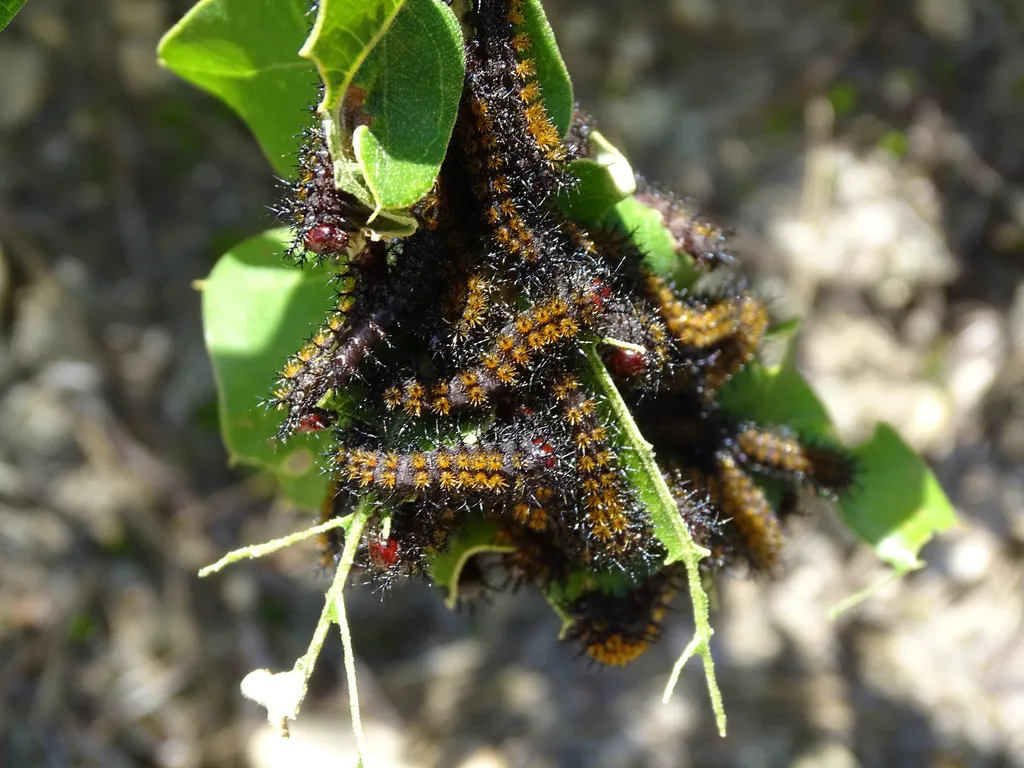

Where Buck Moth Caterpillars Are Found
Hover over states to see their names. Green regions indicate where buck moth caterpillars have been reported.
Buck Moth Caterpillar Identification Guide
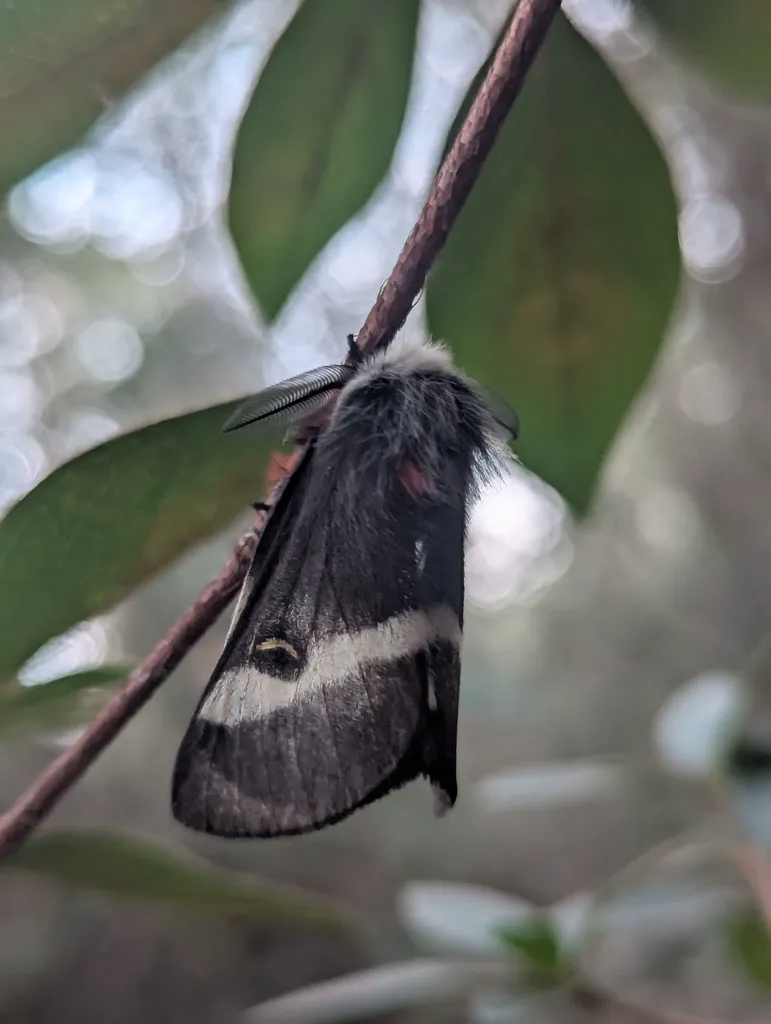
The buck moth caterpillar (Hemileuca maia) is one of the most painful stinging caterpillars in eastern North America. It belongs to the giant silk moth family Saturniidae. The common name comes from the adult moths flying in fall during deer hunting (“buck”) season. The adult moths are harmless and have bold black-and-white wings. But the caterpillar stage delivers a painful venomous sting, so anyone near oak trees in spring should use caution.
Physical Characteristics
Mature buck moth caterpillars are about 2 to 3 inches long with a thick, round body. The body is typically black or dark brown and covered with rows of bumps (called tubercles) that have long, branching spines. These spines stick out from every body segment, giving the caterpillar a bristly look. Small, round white spots dot the sides and back, and the head is often reddish-brown.
Young caterpillars look similar but are smaller and lighter, sometimes brownish or orange. They are social feeders that cluster together on oak leaves early on. After a few growth stages, they spread out and feed alone. The venomous spines can sting from the moment the caterpillar hatches, so even small ones should never be touched.
The caterpillar has three pairs of true legs on the front body and five pairs of soft, fleshy legs on the back used to grip leaves.
Adult Buck Moth
Adult buck moths are day-flying moths with a wingspan of about 2 to 3 inches. Their wings are dark brown to black with a bold white band across both the front and back wings. Each back wing also has a small dark eyespot. Males are slightly smaller than females and fly quickly during the day.
Unlike most moths, adult buck moths do not eat at all. Their mouthparts are not fully formed, so they live only one to two weeks. Males use their feathery antennae to find females. Females lay eggs in tight rings around small twigs. The eggs stay on the branches through winter and hatch the next spring.
Similar Stinging Caterpillars
Several other stinging caterpillars live in the same areas and may be confused with the buck moth caterpillar:
-
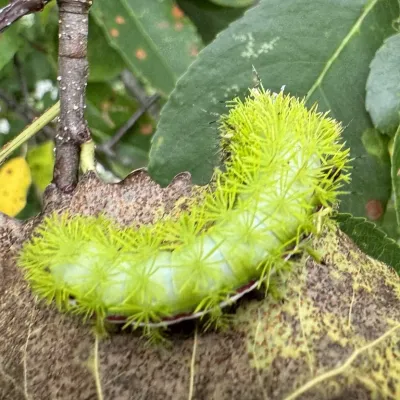
Io moth caterpillar (Automeris io) is bright green with a white side stripe edged in red. Its green color is very different from the buck moth’s dark body, though both have branching venomous spines.
-
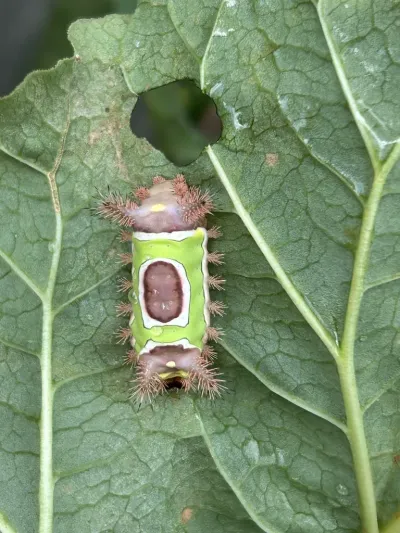
Saddleback caterpillar (Acharia stimulea) has a brown saddle-shaped mark on a bright green body. It is flat and slug-like, unlike the buck moth caterpillar’s round shape.
-
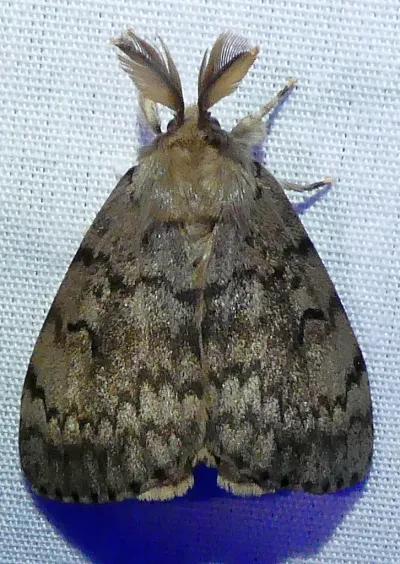
Spongy moth caterpillar (Lymantria dispar) has rows of blue and red dots along its back and is covered in tufted hairs instead of hollow spines. It can cause skin rashes but does not truly sting.
-
Hickory tussock moth caterpillar (Lophocampa caryae) is white with black tufts and pencil-like hair bundles. Its fuzzy, white look is very different from the buck moth’s dark color and stiff spines.
Buck Moth Caterpillar Behavior and Biology
Habitat and Host Plants
Buck moth caterpillars feed mainly on oak trees (Quercus spp.). Common host trees include live oak, scrub oak, white oak, blackjack oak, willow oak, and red oak. Willow and a few other trees can also serve as food sources. Around homes, you are most likely to find them on shade oaks in yards, parks, playgrounds, and along sidewalks. In the wild, they live in oak barrens, scrubby oak woods, and pine-oak forests.
Young caterpillars can strip leaves from branches when they feed in groups. Still, buck moth caterpillars are more of a stinging concern than a tree damage problem in most cases.
Life Cycle
Buck moths go through four life stages: egg, larva (caterpillar), pupa, and adult moth.
Females lay eggs in tight rings around small twigs in late fall. The eggs stay on the branches through winter and hatch the next spring, usually in April or May, as oak leaves start to open. Young caterpillars march along branches in tight groups and feed side by side. After two or three growth stages, they split up and feed on their own.
The caterpillars go through five growth stages over several weeks. Then they burrow into leaf litter or shallow soil to pupate. They stay underground through summer. Adults come out in fall, usually October through November, to mate and lay eggs. Buck moths produce one generation per year. In some areas, pupae can stay dormant for up to two years, which makes local numbers change from year to year.
Stinging Mechanism
The buck moth caterpillar’s branching spines are hollow and linked to venom glands at their base. When the spines touch skin, even lightly, the tips break off and push venom into the tissue. This causes a sharp burning feeling right away, followed by redness, welts, and swelling.
This type of sting reaction is called caterpillar dermatitis. It usually clears up within a few hours for most people. Some people with higher sensitivity may have stronger or longer-lasting reactions. Even dead buck moth caterpillars can still sting because the hollow spines can still break the skin and release venom.
Seasonal Activity
Buck moth caterpillars show up at two times of year. Caterpillars are out from about April through June, with the highest sting risk in April and May. Adult moths fly from October through November. Between these two periods, the species is underground as pupae and you will not see them.
In the Southeast and Gulf Coast, caterpillars may appear as early as March. Adult moths can fly as late as December in parts of Florida. In northern states, the season is shorter, with caterpillars most active in May and June.
Treatment Methods for Buck Moth Caterpillars
Buck moth caterpillars are more of a stinging hazard than a tree pest. The goal of management is to reduce the chance of people getting stung, especially in busy areas like playgrounds, parks, and yards with oak trees.
Prevention and Avoidance
Awareness is the most effective defense against buck moth caterpillar stings:
- Wear thick gloves and long sleeves when pruning oaks, raking leaves, or working under tree canopy during spring months.
- Inspect branches and leaves before grabbing or reaching into oak canopy, especially from April through June.
- Teach children to avoid touching caterpillars, particularly dark-colored or spiny ones found on oak trees.
- Check outdoor furniture, playground equipment, and hanging laundry for caterpillars that may have dropped from overhead branches.
Physical Removal
If you find caterpillars near walkways, play areas, or seating, remove them carefully with thick leather gloves, tongs, or a stick. Drop them into a bucket of soapy water. Never touch them with bare hands. If a group of young caterpillars is feeding on one branch, you can prune the branch and seal it in a bag for disposal.
In winter, look for egg rings on oak twigs. These look like neat bands of small eggs wrapped around thin branches. Pruning these egg masses before spring can cut down on caterpillar numbers the next year.
Biological and Chemical Controls
Bacillus thuringiensis var. kurstaki (Btk) is a natural soil bacterium that kills caterpillars when they eat treated leaves. It works best when sprayed on foliage while caterpillars are young and feeding. Be sure to coat both the tops and bottoms of leaves. Spinosad is another natural product that controls caterpillars through both contact and feeding.
For ongoing problems or large numbers of caterpillars in public areas, a pest control professional or tree care specialist can evaluate the situation and apply treatments during the caterpillar feeding season.
Treating a Sting
If someone is stung by a buck moth caterpillar:
- Remove embedded spines by pressing adhesive tape firmly against the sting site and peeling it away. Repeat multiple times to extract as many spine fragments as possible.
- Wash the area thoroughly with soap and water.
- Apply ice wrapped in a cloth to reduce pain and swelling.
- Use over-the-counter remedies such as oral antihistamines or topical hydrocortisone cream to manage itching and inflammation.
- Do not rub the affected area, as this can drive spine tips deeper into the skin.
- Seek medical attention if symptoms spread beyond the sting site, persist for more than a day, or include difficulty breathing, nausea, or dizziness.
This information is for general educational purposes only and is not medical advice. Always consult a healthcare provider for medical concerns related to insect stings or allergic reactions.
References
Other Moths
Explore other species in the moths family
Commonly Confused With
Buck Moth Caterpillars are often mistaken for these similar pests
Where Buck Moth Caterpillars Are Found
Hover over states to see their names. Green regions indicate where buck moth caterpillars have been reported.
Common Questions about Buck Moth Caterpillars
Do buck moth caterpillars sting?
+
Yes, buck moth caterpillars have hollow, branching spines covering their body that are connected to venom-producing glands. Even light contact with the spines causes an immediate burning sting, followed by redness, welts, and localized swelling that typically lasts several hours. The spines can penetrate skin and break off, continuing to release venom.
What does a buck moth caterpillar look like?
+
Buck moth caterpillars are robust, dark-colored caterpillars about 2 to 3 inches long. They have a black or dark brown body covered with rows of raised tubercles bearing long, multi-branched spines. Most mature larvae display small white dots along the body and a reddish-brown head. Young caterpillars are smaller and often feed in tight clusters on oak leaves.
Are buck moth caterpillars dangerous?
+
For most people, a buck moth caterpillar sting causes temporary but intense pain, welts, and localized swelling that resolves within hours. However, some individuals may experience more severe allergic reactions including widespread swelling, nausea, or difficulty breathing. People with known insect venom sensitivities should seek medical attention promptly if stung.
What should I do if I get stung by a buck moth caterpillar?
+
Immediately press adhesive tape firmly against the sting site and peel it away to remove embedded spine fragments. Repeat several times. Wash the area with soap and water, apply ice wrapped in a cloth to reduce swelling, and use an over-the-counter antihistamine or hydrocortisone cream. Do not rub the area, as this can push spines deeper. Seek medical attention if symptoms spread or include difficulty breathing.
Where are buck moth caterpillars found?
+
Buck moth caterpillars are found throughout eastern North America, from Maine south to Florida and west to Kansas and Texas. They feed primarily on oak trees, including live oak, scrub oak, white oak, and blackjack oak. You are most likely to encounter them in spring (April through May) when the caterpillars are actively feeding on foliage.
What do buck moth caterpillars turn into?
+
Buck moth caterpillars pupate in leaf litter or soil and emerge as adult buck moths (Hemileuca maia) in the fall, typically October through November. Adults are striking day-flying moths with a wingspan of about 2 to 3 inches, featuring dark wings marked with white bands. Unlike most moths, buck moths fly during the daytime and do not feed as adults.
When are buck moth caterpillars most active?
+
Buck moth caterpillars are most active in spring, typically April through May, when they hatch from overwintering eggs and feed on oak foliage. Adult moths emerge in the fall, usually October through November. The species produces one generation per year, so you will only encounter caterpillars during the spring feeding window.

With five years of hands-on experience in the pest control industry, George Schulz is a registered technician with the Virginia Pest Management Association and a proud third-generation professional in a family business that's been protecting homes for over 57 years. He manages and trains a team of service pros while also leading internal research efforts—recently spearheading a deep-dive review of thousands of documents on pest control materials to hand-pick the most kid and pet friendly, most effective solutions tailored specifically for homes in the DC metro area.